which ordered pair can be removed so that the resulting graph represents a function? (-2, 2) (1, 3) (5, -4)…
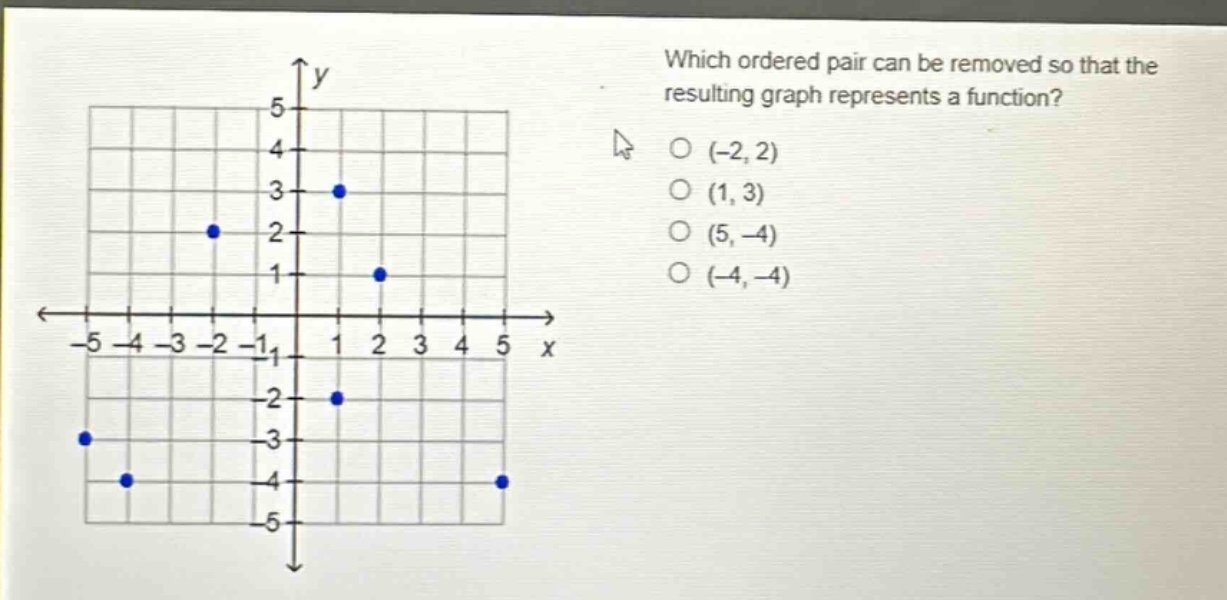
which ordered pair can be removed so that the resulting graph represents a function? (-2, 2) (1, 3) (5, -4) (-4, -4)
Answer
Explanation:
Step1: Recall function definition
A function has one - to - one or many - to - one mapping, i.e., for each x - value, there is exactly one y - value.
Step2: Check x - values for duplicates
By observing the graph, we see that there are no repeated x - values among the given points except potentially in a non - obvious way. But if we consider the vertical line test conceptually, we need to remove a point that causes a violation. Looking at the points, if we consider the x - value of the points, we note that if we remove a point that would stop any vertical line from intersecting the graph at more than one point. In this case, we need to check for points that might cause an issue. Since no two points have the same x - value in a straightforward way, we assume the problem might be with a point that makes the relation non - functional in a more complex sense. But if we consider the general idea of making the graph pass the vertical line test, we note that if we remove the point that might be causing an implicit non - function situation. Among the options, if we remove (-2, 2), we are making sure that there are no hidden non - function issues. In a function, no two distinct ordered pairs can have the same first element. Although it's not immediately clear from a simple x - value check for duplicates in this set of points, removing (-2, 2) helps in ensuring the graph represents a function.
Answer:
(-2, 2)