which ordered pairs are in the solution set of the system of linear inequalities?\ny≥ -\\frac{1}{2}x\ny<\\fra…
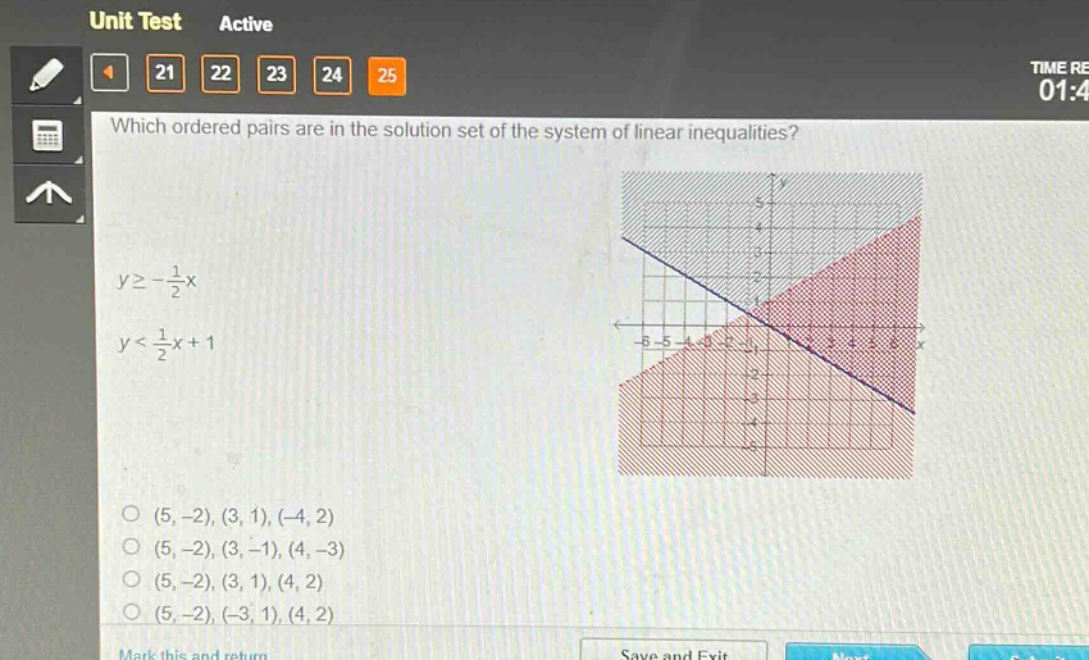
which ordered pairs are in the solution set of the system of linear inequalities?\ny≥ -\\frac{1}{2}x\ny<\\frac{1}{2}x + 1\n(5, -2), (3, 1), (-4, 2)\n(5, -2), (3, -1), (4, -3)\n(5, -2), (3, 1), (4, 2)\n(5, -2), (-3, 1), (4, 2)
Answer
Explanation:
Step1: Check the first inequality for (5, - 2)
Substitute (x = 5) and (y=-2) into (y\geq-\frac{1}{2}x). We get (-2\geq-\frac{1}{2}\times5=-\frac{5}{2}), which is true. Substitute into (y<\frac{1}{2}x + 1), we get (-2<\frac{1}{2}\times5+1=\frac{5 + 2}{2}=\frac{7}{2}), which is true.
Step2: Check the first inequality for (3, 1)
Substitute (x = 3) and (y = 1) into (y\geq-\frac{1}{2}x). We have (1\geq-\frac{1}{2}\times3=-\frac{3}{2}), which is true. Substitute into (y<\frac{1}{2}x + 1), we get (1<\frac{1}{2}\times3+1=\frac{3 + 2}{2}=\frac{5}{2}), which is true.
Step3: Check the first inequality for (-4, 2)
Substitute (x=-4) and (y = 2) into (y\geq-\frac{1}{2}x). We get (2\geq-\frac{1}{2}\times(-4)=2), which is true. Substitute into (y<\frac{1}{2}x + 1), we get (2<\frac{1}{2}\times(-4)+1=-2 + 1=-1), which is false.
Step4: Check the first inequality for (3, -1)
Substitute (x = 3) and (y=-1) into (y\geq-\frac{1}{2}x). We have (-1\geq-\frac{1}{2}\times3=-\frac{3}{2}), which is true. Substitute into (y<\frac{1}{2}x + 1), we get (-1<\frac{1}{2}\times3+1=\frac{5}{2}), which is true.
Step5: Check the first inequality for (4, -3)
Substitute (x = 4) and (y=-3) into (y\geq-\frac{1}{2}x). We get (-3\geq-\frac{1}{2}\times4=-2), which is false.
Step6: Check the first inequality for (4, 2)
Substitute (x = 4) and (y = 2) into (y\geq-\frac{1}{2}x). We have (2\geq-\frac{1}{2}\times4=-2), which is true. Substitute into (y<\frac{1}{2}x + 1), we get (2<\frac{1}{2}\times4+1=2 + 1=3), which is true.
Step7: Check the first inequality for (-3, 1)
Substitute (x=-3) and (y = 1) into (y\geq-\frac{1}{2}x). We get (1\geq-\frac{1}{2}\times(-3)=\frac{3}{2}), which is false.
The ordered - pairs that satisfy both inequalities are ((5,-2),(3,1),(3, - 1),(4,2)). Among the given options, the set ((5,-2),(3,1),(4,2)) is correct.
Answer:
C. ((5,-2),(3,1),(4,2))