ori needed at least $1.47 in postage to mail an envelope to his cousin overseas. if x represents the number…
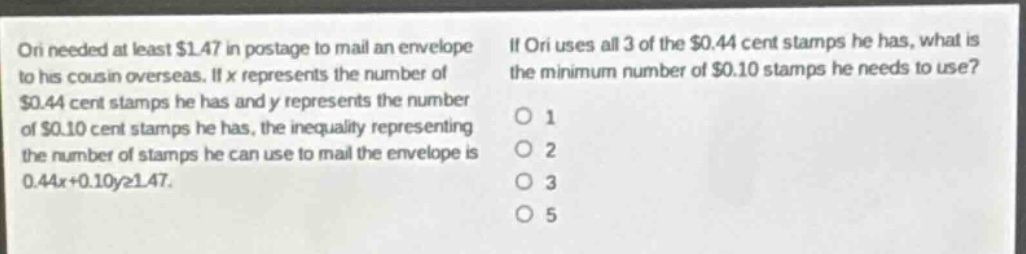
ori needed at least $1.47 in postage to mail an envelope to his cousin overseas. if x represents the number of $0.44 cent stamps he has and y represents the number of $0.10 cent stamps he has, the inequality representing the number of stamps he can use to mail the envelope is 0.44x + 0.10y≥1.47. if ori uses all 3 of the $0.44 cent stamps he has, what is the minimum number of $0.10 stamps he needs to use? 1 2 3 5
Answer
Explanation:
Step1: Substitute $x = 3$ into the inequality
Substitute $x = 3$ into $0.44x+0.10y\geq1.47$. We get $0.44\times3 + 0.10y\geq1.47$.
Step2: Calculate the value of $0.44\times3$
$0.44\times3=1.32$, so the inequality becomes $1.32 + 0.10y\geq1.47$.
Step3: Isolate the term with $y$
Subtract $1.32$ from both sides of the inequality: $0.10y\geq1.47 - 1.32$. $0.10y\geq0.15$.
Step4: Solve for $y$
Divide both sides of the inequality by $0.10$: $y\geq\frac{0.15}{0.10}=1.5$. Since the number of stamps must be a whole - number, the minimum value of $y$ is 2.
Answer:
2