if $overline{cb}$ bisects $angle acd$, what additional information could be used to prove $\triangle…
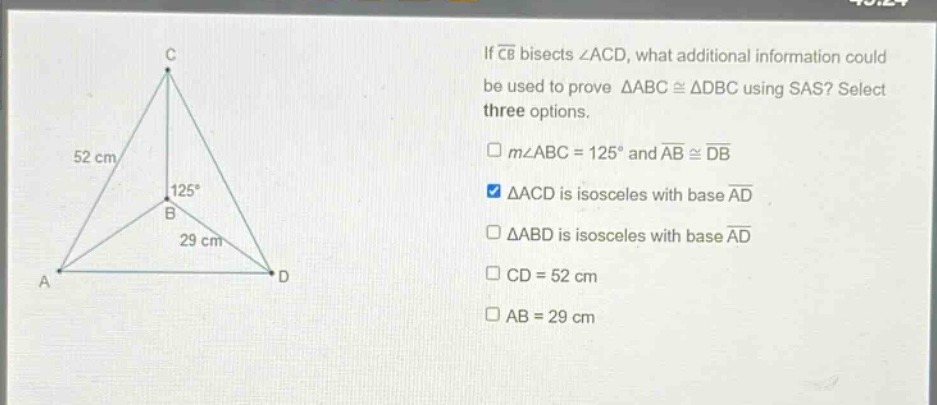
if $overline{cb}$ bisects $angle acd$, what additional information could be used to prove $\triangle abccong\triangle dbc$ using sas? select three options.\n$mangle abc = 125^{circ}$ and $overline{ab}congoverline{db}$\n$\triangle acd$ is isosceles with base $overline{ad}$\n$\triangle abd$ is isosceles with base $overline{ad}$\n$cd = 52$ cm\n$ab = 29$ cm
Answer
Explanation:
Step1: Recall SAS congruence criterion
SAS (Side - Angle - Side) requires two pairs of congruent sides and the included angle congruent. Given that $\overline{CB}$ bisects $\angle ACD$, so $\angle ACB=\angle DCB$.
Step2: Analyze each option
- For $m\angle ABC = 125^{\circ}$ and $\overline{AB}\cong\overline{DB}$: We don't know if the included angles between the sides are the correct ones for SAS, so this is not sufficient.
- For $\triangle ACD$ is isosceles with base $\overline{AD}$: If $\triangle ACD$ is isosceles with base $\overline{AD}$, then $AC = CD$. Also, $\angle ACB=\angle DCB$ (because $\overline{CB}$ bisects $\angle ACD$) and $CB$ is common. So, by SAS, $\triangle ABC\cong\triangle DBC$.
- For $\triangle ABD$ is isosceles with base $\overline{AD}$: This gives information about $\triangle ABD$ and not directly relevant to proving $\triangle ABC\cong\triangle DBC$ using SAS.
- For $CD = 52$ cm: Since $AC = 52$ cm and $CD = 52$ cm, $AC=CD$. Also, $\angle ACB=\angle DCB$ (because $\overline{CB}$ bisects $\angle ACD$) and $CB$ is common. So, by SAS, $\triangle ABC\cong\triangle DBC$.
- For $AB = 29$ cm: This doesn't help in establishing the SAS - congruence as we don't have the right combination of sides and included angle.
Answer:
$\triangle ACD$ is isosceles with base $\overline{AD}$, $CD = 52$ cm