if $overline{cb}$ bisects $angle acd$, what additional information could be used to prove $\triangle…
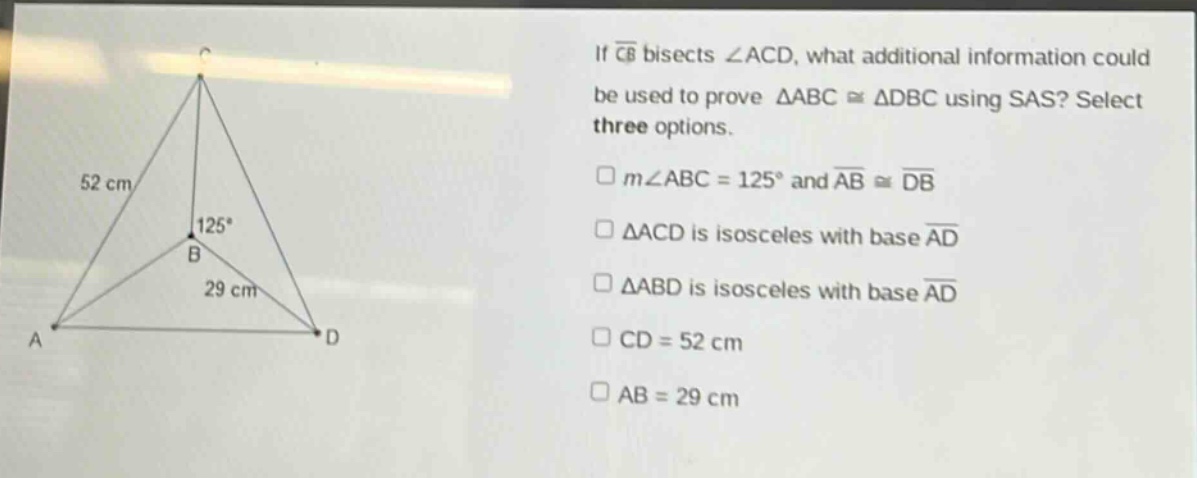
if $overline{cb}$ bisects $angle acd$, what additional information could be used to prove $\triangle abccong\triangle dbc$ using sas? select three options.\n$square mangle abc = 125^{circ}$ and $overline{ab}congoverline{db}$\n$square\triangle acd$ is isosceles with base $overline{ad}$\n$square\triangle abd$ is isosceles with base $overline{ad}$\n$square cd = 52$ cm\n$square ab = 29$ cm
Answer
Explanation:
Step 1: Identify SAS requirements
SAS congruence requires two sides and the included angle to be equal. For △ABC ≅ △DBC, common side BC is shared. CB bisects ∠ACD, so ∠ACB = ∠DCB (included angle at C).
Step 2: Evaluate AC = DC conditions
- △ACD is isosceles with base AD (AC = DC, satisfies SAS with ∠ACB = ∠DCB and BC = BC).
- CD = 52 cm (since AC = 52 cm, AC = DC, same as above condition).
Step 3: Evaluate AB = DB with included angle
- m∠ABC = 125° and AB ≅ DB (if ∠ABC = ∠DBC = 125°, then AB = DB, BC = BC, and included angle at B matches SAS).
Answer:
m∠ABC = 125° and AB ≅ DB, △ACD is isosceles with base AD, CD = 52 cm