the owner of an office building is expanding the length and width of a parking lot by the same amount. the…
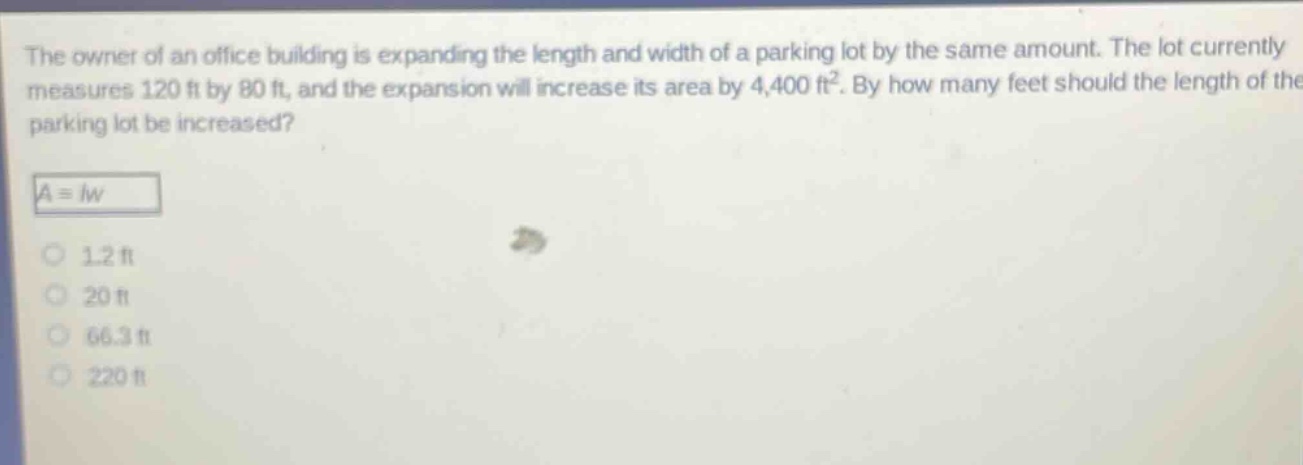
the owner of an office building is expanding the length and width of a parking lot by the same amount. the lot currently measures 120 ft by 80 ft, and the expansion will increase its area by 4,400 ft². by how many feet should the length of the parking lot be increased?\n$a = lw$\n1.2 ft\n20 ft\n66.3 ft\n220 ft
Answer
Explanation:
Step1: Let the increase in length and width be (x) feet.
The original area (A_1 = 120\times80=9600) square - feet. The new length is ((120 + x)) feet and the new width is ((80 + x)) feet. So the new area (A_2=(120 + x)(80 + x)). We know that (A_2=A_1 + 4400). Substituting the values, we get ((120 + x)(80 + x)=9600+4400).
Step2: Expand the left - hand side.
Using the FOIL method: ((120 + x)(80 + x)=120\times80+120x+80x+x^{2}=9600 + 200x+x^{2}). The equation becomes (9600 + 200x+x^{2}=9600+4400).
Step3: Simplify the equation.
Subtract 9600 from both sides: (x^{2}+200x - 4400=0). Divide the entire equation by 4: (x^{2}/4 + 50x-1100 = 0), or (x^{2}+200x - 4400=0). We can also use the quadratic formula (x=\frac{-b\pm\sqrt{b^{2}-4ac}}{2a}) for the quadratic equation (ax^{2}+bx + c = 0). Here, (a = 1), (b = 200), (c=-4400). First, calculate the discriminant (\Delta=b^{2}-4ac=(200)^{2}-4\times1\times(-4400)=40000 + 17600=57600). Then (x=\frac{-200\pm\sqrt{57600}}{2}=\frac{-200\pm240}{2}). We have two solutions for (x): (x_1=\frac{-200 + 240}{2}=\frac{40}{2}=20) and (x_2=\frac{-200-240}{2}=\frac{-440}{2}=-220). Since (x) represents a length, (x>0).
Answer:
B. (20) ft