pablo generates the function $f(x)=\frac{3}{2}(\frac{5}{2})^{x - 1}$ to determine the $x^{th}$ number in a…
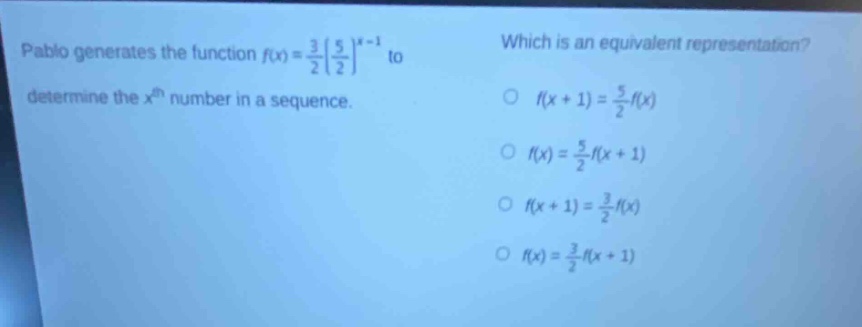
pablo generates the function $f(x)=\frac{3}{2}(\frac{5}{2})^{x - 1}$ to determine the $x^{th}$ number in a sequence. which is an equivalent representation? $f(x + 1)=\frac{5}{2}f(x)$ $f(x)=\frac{5}{2}f(x + 1)$ $f(x + 1)=\frac{3}{2}f(x)$ $f(x)=\frac{3}{2}f(x + 1)$
Answer
Explanation:
Step1: Write out (f(x)) and (f(x + 1))
Given (f(x)=\frac{3}{2}(\frac{5}{2})^{x - 1}), then (f(x+1)=\frac{3}{2}(\frac{5}{2})^{(x + 1)-1}=\frac{3}{2}(\frac{5}{2})^{x}).
Step2: Express (f(x + 1)) in terms of (f(x))
We know that (f(x+1)=\frac{3}{2}(\frac{5}{2})^{x}) and (f(x)=\frac{3}{2}(\frac{5}{2})^{x - 1}). Then (\frac{f(x + 1)}{f(x)}=\frac{\frac{3}{2}(\frac{5}{2})^{x}}{\frac{3}{2}(\frac{5}{2})^{x - 1}}). Using the rule of exponents (\frac{a^{m}}{a^{n}}=a^{m - n}), we have (\frac{f(x + 1)}{f(x)}=\frac{5}{2}), so (f(x + 1)=\frac{5}{2}f(x)).
Answer:
(f(x + 1)=\frac{5}{2}f(x)) (the first - option)