which pair of complex numbers has a real - number product?\n(1 + 3i)(6i)\n(1 + 3i)(2 - 3i)\n(1 + 3i)(1…
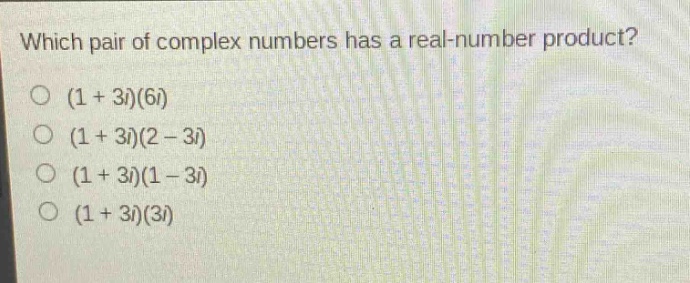
which pair of complex numbers has a real - number product?\n(1 + 3i)(6i)\n(1 + 3i)(2 - 3i)\n(1 + 3i)(1 - 3i)\n(1 + 3i)(3i)
Answer
Explanation:
Step1: Expand ((1 + 3i)(6i))
Use the distributive property (a(b + c)=ab+ac). Here (a = 6i), (b = 1), (c = 3i). ((1 + 3i)(6i)=6i+18i^{2}). Since (i^{2}=-1), we have (6i - 18=-18 + 6i) (not a real - number).
Step2: Expand ((1 + 3i)(2-3i))
Use the FOIL method ((a + b)(c + d)=ac+ad+bc+bd). ((1 + 3i)(2-3i)=1\times2+1\times(-3i)+3i\times2+3i\times(-3i)) (=2-3i + 6i-9i^{2}) (=2 + 3i+9) (because (i^{2}=-1)) (=11 + 3i) (not a real - number).
Step3: Expand ((1 + 3i)(1-3i))
Use the formula ((a + b)(a - b)=a^{2}-b^{2}). Here (a = 1), (b = 3i). ((1 + 3i)(1-3i)=1^{2}-(3i)^{2}) (=1-9i^{2}). Since (i^{2}=-1), we get (1+9 = 10) (a real - number).
Step4: Expand ((1 + 3i)(3i))
Use the distributive property (a(b + c)=ab+ac). Here (a = 3i), (b = 1), (c = 3i). ((1 + 3i)(3i)=3i+9i^{2}). Since (i^{2}=-1), we have (3i - 9=-9 + 3i) (not a real - number).
Answer:
((1 + 3i)(1-3i))