for each pair of triangles, determine whether the hypotenuse - leg (hl) congruence property can be used to…
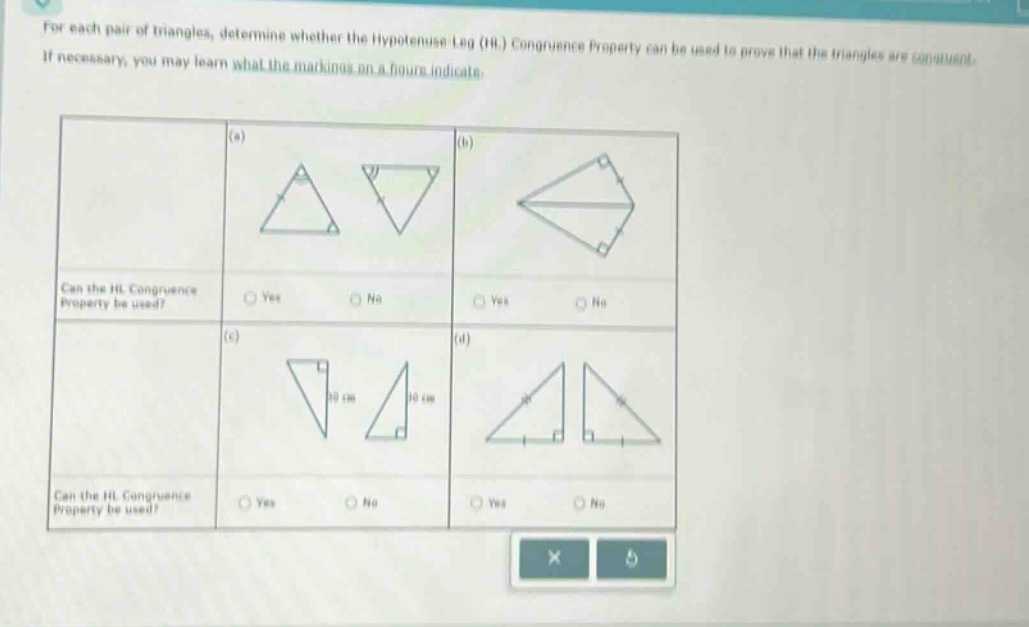
for each pair of triangles, determine whether the hypotenuse - leg (hl) congruence property can be used to prove that the triangles are congruent. if necessary, you may learn what the markings on a figure indicate. (a) (b) can the hl congruence property be used? yes no yes no (c) (d) can the hl congruence property be used? yes no yes no
Answer
Explanation:
Step1: Recall HL - Hypotenuse - Leg congruence property
The HL congruence property states that if the hypotenuse and a leg of one right - triangle are congruent to the hypotenuse and a leg of another right - triangle, then the two right - triangles are congruent.
Step2: Analyze part (a)
In part (a), we have two right - triangles. But we do not know if the hypotenuses are congruent and we do not know if the corresponding legs are congruent. So, the answer is No.
Step3: Analyze part (b)
In part (b), we have two right - triangles. The common side is the hypotenuse for both triangles and one of the legs is marked as congruent for both triangles. So, the answer is Yes.
Step4: Analyze part (c)
In part (c), we have two right - triangles. We know the lengths of one leg are equal (both 10 cm), but we do not know about the hypotenuses. So, the answer is No.
Step5: Analyze part (d)
In part (d), we have two right - triangles. We know the lengths of one leg are equal (marked with single tick) and the hypotenuses are equal (marked with double ticks). So, the answer is Yes.
Answer:
(a) No (b) Yes (c) No (d) Yes