pams eye - level height is 256 feet above sea level and adams eye - level height is 400 feet above sea…
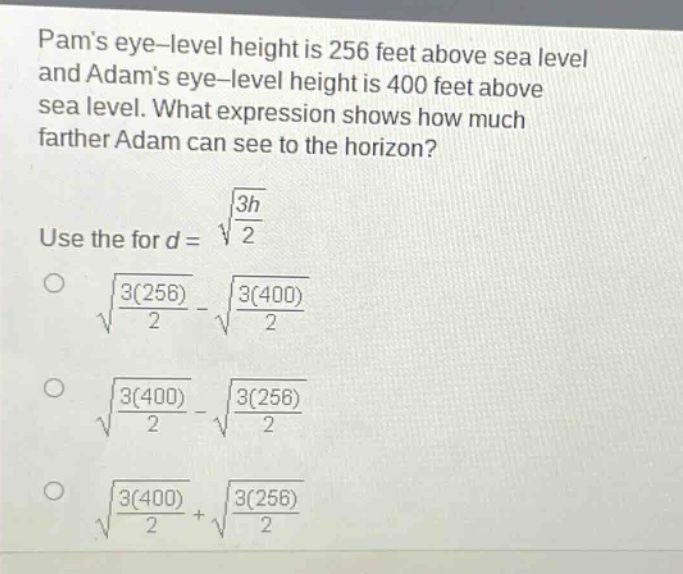
pams eye - level height is 256 feet above sea level and adams eye - level height is 400 feet above sea level. what expression shows how much farther adam can see to the horizon? use the for $d = sqrt{\frac{3h}{2}}$ \n$sqrt{\frac{3(256)}{2}}-sqrt{\frac{3(400)}{2}}$ \n$sqrt{\frac{3(400)}{2}}-sqrt{\frac{3(256)}{2}}$ \n$sqrt{\frac{3(400)}{2}}+sqrt{\frac{3(256)}{2}}$
Answer
Explanation:
Step1: Find Adam's horizon - distance
The formula for the distance $d$ to the horizon is $d = \sqrt{\frac{3h}{2}}$, where $h$ is the eye - level height above sea level. For Adam, with $h = 400$ feet, his distance to the horizon $d_{Adam}=\sqrt{\frac{3\times400}{2}}$.
Step2: Find Pam's horizon - distance
For Pam, with $h = 256$ feet, her distance to the horizon $d_{Pam}=\sqrt{\frac{3\times256}{2}}$.
Step3: Find the difference
To find how much farther Adam can see than Pam, we subtract Pam's horizon - distance from Adam's horizon - distance. The expression is $\sqrt{\frac{3\times400}{2}}-\sqrt{\frac{3\times256}{2}}$.
Answer:
$\sqrt{\frac{3(400)}{2}}-\sqrt{\frac{3(256)}{2}}$