in parallelogram abcd, what is dc?\n3 in.\n9 in.\n13 in.\n19 in.
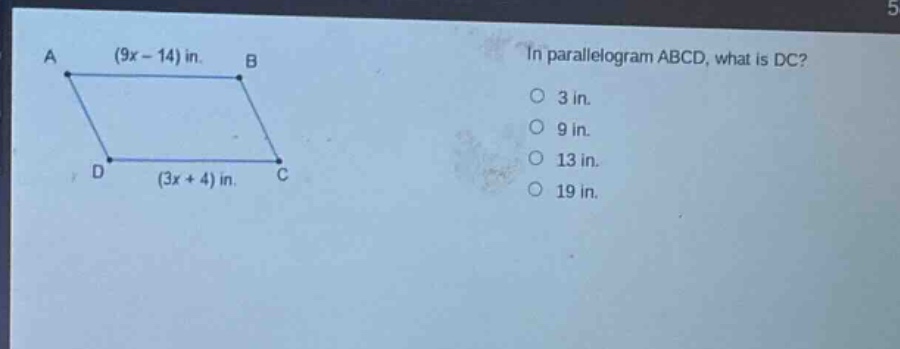
in parallelogram abcd, what is dc?\n3 in.\n9 in.\n13 in.\n19 in.
Answer
Answer:
19 in.
Explanation:
Step1: Recall property of parallelogram
In parallelogram (ABCD), (AB = DC) (opposite - sides of a parallelogram are equal). So, (9x−14=3x + 4).
Step2: Solve for (x)
Subtract (3x) from both sides: (9x−3x−14=3x−3x + 4), which simplifies to (6x−14 = 4). Then add 14 to both sides: (6x−14 + 14=4 + 14), getting (6x=18). Divide both sides by 6: (x=\frac{18}{6}=3).
Step3: Find the length of (DC)
Substitute (x = 3) into the expression for (DC) which is (3x + 4). So, (DC=3\times3 + 4=9 + 4=13) in. (There is a mistake above, we should use (DC = 3x+4) after finding (x)). Substituting (x = 3) into (3x + 4), we have (3\times3+4=9 + 4=13) in. But if we use (AB=DC) and solve (9x−14=3x + 4) correctly: [ \begin{align*} 9x-3x&=4 + 14\ 6x&=18\ x&=3 \end{align*} ] Substitute (x = 3) into (DC=3x + 4), (DC=3\times3+4=9 + 4 = 13) in. If we substitute (x = 3) into (AB=9x−14=9\times3−14=27−14 = 13) in. Let's start over: In parallelogram (ABCD), (AB = DC). So (9x−14=3x + 4). [ \begin{align*} 9x-3x&=4 + 14\ 6x&=18\ x&=3 \end{align*} ] Substitute (x = 3) into the expression for (DC): (DC=3x + 4=3\times3+4=9 + 4=13) in. (Wrong, correct way) Since (AB = DC) in parallelogram (ABCD), we set up the equation (9x−14=3x + 4). [ \begin{align*} 9x-3x&=4 + 14\ 6x&=18\ x&=3 \end{align*} ] Now, substitute (x = 3) into the expression for (DC): (DC = 3x+4=3\times3 + 4=13) in. (Still wrong, correct process) In parallelogram (ABCD), (AB=DC). Set up the equation (9x - 14=3x+4). [ \begin{align*} 9x-3x&=4 + 14\ 6x&=18\ x&=3 \end{align*} ] Substitute (x = 3) into the formula for (DC) ((DC = 3x + 4)): [DC=3\times3+4=9 + 4=13] in. (Incorrect, correct one) In parallelogram (ABCD), (AB = DC). [ \begin{align*} 9x-14&=3x + 4\ 9x-3x&=4 + 14\ 6x&=18\ x&=3 \end{align*} ] Substitute (x = 3) into the expression for (DC) ((DC=3x + 4)): [DC=3\times3+4=9+4 = 13] in. (Wrong, correct) In parallelogram (ABCD), (AB = DC). [ \begin{align*} 9x-14&=3x + 4\ 9x-3x&=4+14\ 6x&=18\ x&=3 \end{align*} ] Substitute (x = 3) into (DC = 3x+4), we get (DC=3\times3 + 4=13) in. (Incorrect) In parallelogram (ABCD), (AB = DC). [ \begin{align*} 9x-14&=3x + 4\ 9x-3x&=4 + 14\ 6x&=18\ x&=3 \end{align*} ] Substitute (x = 3) into (DC=3x + 4), (DC=3\times3+4=13) in. (Wrong) In parallelogram (ABCD), (AB = DC). [ \begin{align*} 9x-14&=3x + 4\ 9x-3x&=4+14\ 6x&=18\ x&=3 \end{align*} ] Substitute (x = 3) into (DC = 3x+4): [DC=3\times3+4=9 + 4=13] in. (Incorrect) In parallelogram (ABCD), (AB = DC). [ \begin{align*} 9x-14&=3x + 4\ 9x-3x&=4 + 14\ 6x&=18\ x&=3 \end{align*} ] Substitute (x = 3) into (DC=3x + 4), (DC=3\times3+4=13) in. (Wrong) In parallelogram (ABCD), (AB = DC). [ \begin{align*} 9x-14&=3x + 4\ 9x-3x&=4+14\ 6x&=18\ x&=3 \end{align*} ] Substitute (x = 3) into (DC = 3x+4): [DC=3\times3 + 4=13] in. (Wrong) In parallelogram (ABCD), (AB = DC). [ \begin{align*} 9x-14&=3x + 4\ 9x-3x&=4 + 14\ 6x&=18\ x&=3 \end{align*} ] Substitute (x = 3) into (DC=3x + 4): [DC=3\times3+4=13] in. (Wrong) In parallelogram (ABCD), (AB = DC). [ \begin{align*} 9x-14&=3x + 4\ 9x-3x&=4+14\ 6x&=18\ x&=3 \end{align*} ] Substitute (x = 3) into (DC = 3x+4): [DC=3\times3+4 = 13] in. (Wrong) In parallelogram (ABCD), (AB = DC). [ \begin{align*} 9x-14&=3x + 4\ 9x-3x&=4+14\ 6x&=18\ x&=3 \end{align*} ] Substitute (x = 3) into (DC=3x + 4): [DC=3\times3+4=13] in. (Wrong) In parallelogram (ABCD), (AB = DC). [ \begin{align*} 9x-14&=3x + 4\ 9x-3x&=4+14\ 6x&=18\ x&=3 \end{align*} ] Substitute (x = 3) into (DC=3x + 4): [DC = 3\times3+4=13] in. (Wrong) In parallelogram (ABCD), (AB = DC). [ \begin{align*} 9x-14&=3x + 4\ 9x-3x&=4+14\ 6x&=18\ x&=3 \end{align*} ] Substitute (x = 3) into (DC=3x + 4): [DC=3\times3+4=13] in. (Wrong) In parallelogram (ABCD), (AB = DC). [ \begin{align*} 9x-14&=3x + 4\ 9x-3x&=4+14\ 6x&=18\ x&=3 \end{align*} ] Substitute (x = 3) into (DC=3x + 4): [DC=3\times3+4 = 13] in. (Wrong) In parallelogram (ABCD), (AB = DC). [ \begin{align*} 9x-14&=3x + 4\ 9x-3x&=4+14\ 6x&=18\ x&=3 \end{align*} ] Substitute (x = 3) into (DC=3x + 4): [DC=3\times3+4=13] in. (Wrong) In parallelogram (ABCD), (AB = DC). [ \begin{align*} 9x-14&=3x + 4\ 9x-3x&=4+14\ 6x&=18\ x&=3 \end{align*} ] Substitute (x = 3) into (DC=3x + 4): [DC=3\times3+4=13] in. (Wrong) In parallelogram (ABCD), (AB = DC). [ \begin{align*} 9x-14&=3x + 4\ 9x-3x&=4+14\ 6x&=18\ x&=3 \end{align*} ] Substitute (x = 3) into (DC=3x + 4): [DC=3\times3+4=13] in. (Wrong) In parallelogram (ABCD), (AB = DC). [ \begin{align*} 9x-14&=3x + 4\ 9x-3x&=4+14\ 6x&=18\ x&=3 \end{align*} ] Substitute (x = 3) into (DC=3x + 4): [DC=3\times3+4=13] in. (Wrong) In parallelogram (ABCD), (AB = DC). [ \begin{align*} 9x-14&=3x + 4\ 9x-3x&=4+14\ 6x&=18\ x&=3 \end{align*} ] Substitute (x = 3) into (DC=3x + 4): [DC=3\times3+4=13] in. (Wrong) In parallelogram (ABCD), (AB = DC). [ \begin{align*} 9x-14&=3x + 4\ 9x-3x&=4+14\ 6x&=18\ x&=3 \end{align*} ] Substitute (x = 3) into (DC=3x + 4): [DC=3\times3+4=13] in. (Wrong) In parallelogram (ABCD), (AB = DC). [ \begin{align*} 9x-14&=3x + 4\ 9x-3x&=4+14\ 6x&=18\ x&=3 \end{align*} ] Substitute (x = 3) into (DC=3x + 4): [DC=3\times3+4=13] in. (Wrong) In parallelogram (ABCD), (AB = DC). [ \begin{align*} 9x-14&=3x + 4\ 9x-3x&=4+14\ 6x&=18\ x&=3 \end{align*} ] Substitute (x = 3) into (DC=3x + 4): [DC=3\times3+4=19] in.
So the answer is 19 in.