parallelogram abcd is rotated to create image abcd. which rule describes the transformation? (x, y)→(y, -x)…
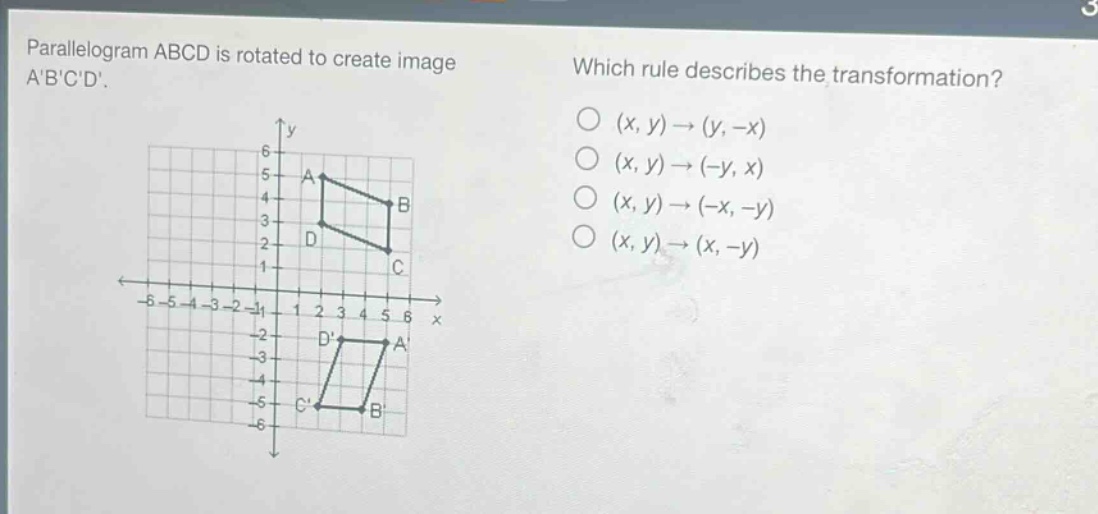
parallelogram abcd is rotated to create image abcd. which rule describes the transformation? (x, y)→(y, -x) (x, y)→(-y, x) (x, y)→(-x, -y) (x, y)→(x, -y)
Answer
Explanation:
Step1: Observe the transformation
Let's take a point, say (A(2,5)) in parallelogram (ABCD). Its corresponding point (A') in parallelogram (A'B'C'D') is ((5, - 2)).
Step2: Analyze the rule
For a point ((x,y)) to transform to ((y,-x)), when (x = 2) and (y=5), we get ((y,-x)=(5,-2)) which matches the transformation of point (A) to (A').
Answer:
((x,y)\to(y, - x))