parallelogram abcd is rotated to create image abcd. which rule describes the transformation? (x,y)→(y, -x)…
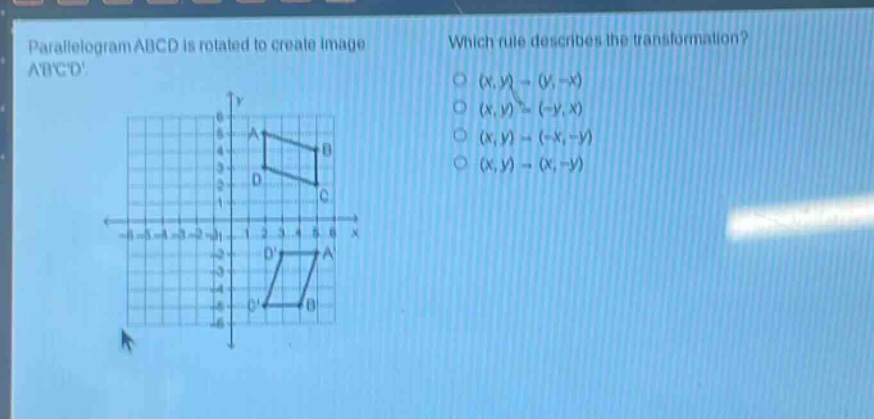
parallelogram abcd is rotated to create image abcd. which rule describes the transformation? (x,y)→(y, -x) (x,y)→(-y, x) (x,y)→(-x, -y) (x,y)→(x, -y)
Answer
Answer:
$(x,y)\to(-y,x)$
Explanation:
Step1: Analyze rotation pattern
Observe the position - change of points.
Step2: Check each option
For a $90^{\circ}$ counter - clockwise rotation about the origin, the rule is $(x,y)\to(-y,x)$. By comparing the original parallelogram $ABCD$ and the rotated parallelogram $A'B'C'D'$, we can see that this rule applies. For example, if we take a point $(x,y)$ in the original figure and apply the rule $(x,y)\to(-y,x)$, it matches the position of the corresponding point in the rotated figure.