parallelogram fghj was dilated and translated to form similar parallelogram fghj. what is the scale factor…
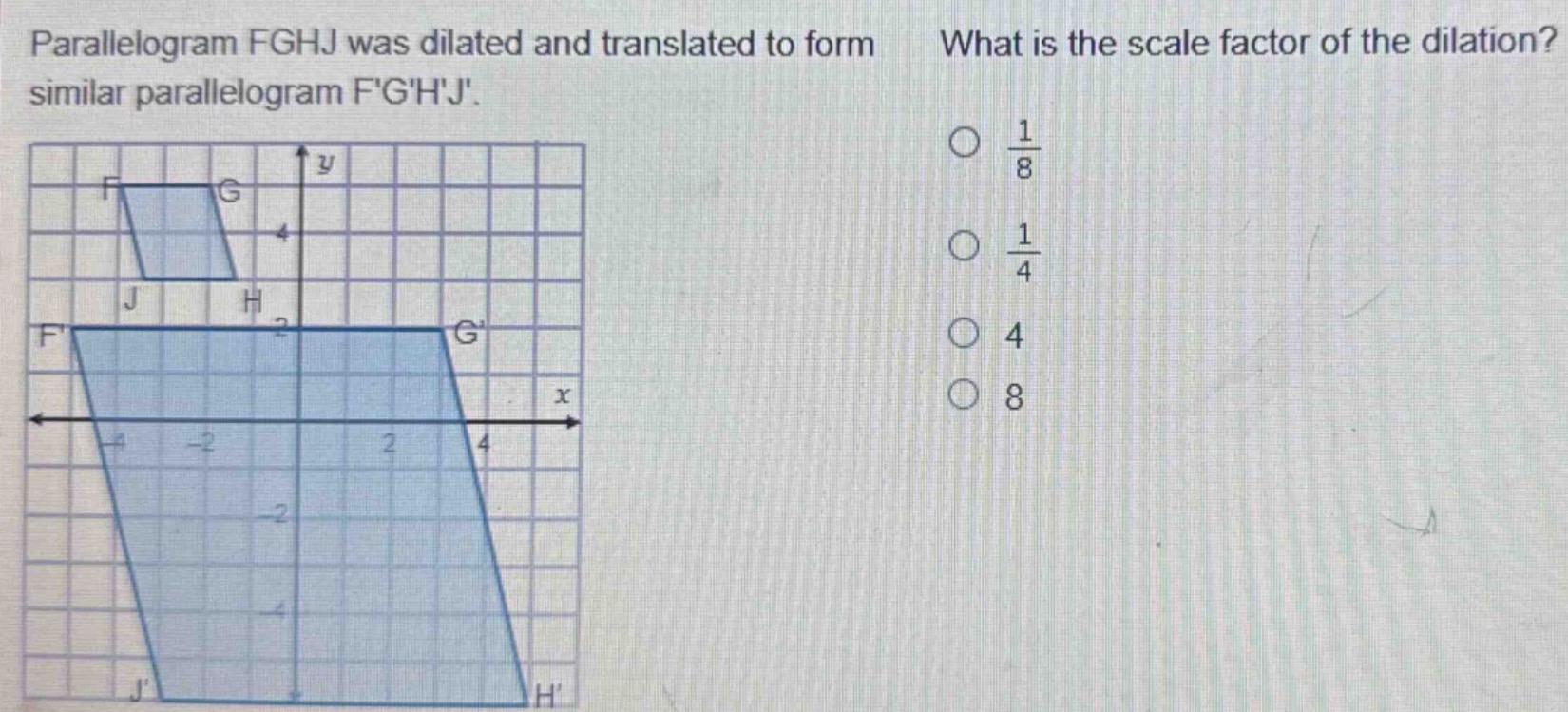
parallelogram fghj was dilated and translated to form similar parallelogram fghj. what is the scale factor of the dilation? $\frac{1}{8}$ $\frac{1}{4}$ 4 8
Answer
Answer:
C. 4
Explanation:
Step1: Select corresponding sides
Choose a side of the original parallelogram and its corresponding side in the dilated - translated parallelogram. For example, consider the horizontal side of parallelogram FGHJ and its corresponding side in F'G'H'J'.
Step2: Measure side - lengths
Count the number of grid - units for the side of the original parallelogram and the dilated parallelogram. Suppose the length of a side of parallelogram FGHJ is 1 unit (by counting grid - squares) and the length of the corresponding side of parallelogram F'G'H'J' is 4 units.
Step3: Calculate scale factor
The scale factor (k) of a dilation is given by the ratio of the length of a side of the dilated figure to the length of the corresponding side of the original figure. So, (k=\frac{\text{length of side in dilated figure}}{\text{length of side in original figure}}=\frac{4}{1} = 4).