a parallelogram is transformed according to the rule (x, y) → (x, y). which is another way to state the…
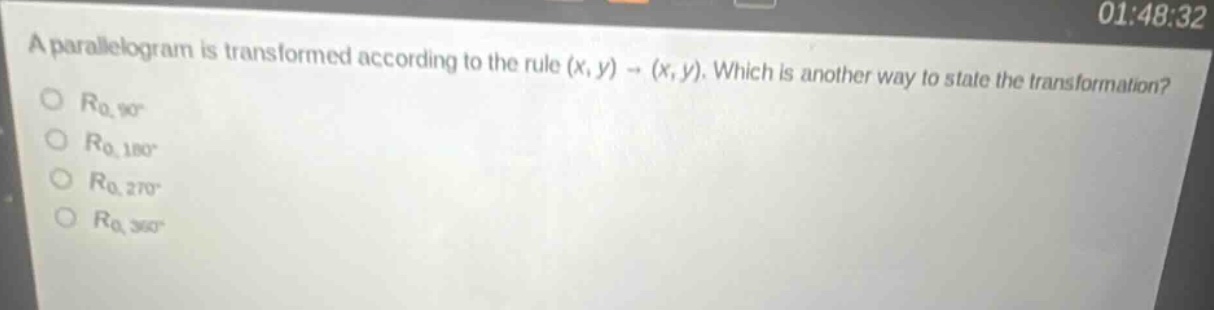
a parallelogram is transformed according to the rule (x, y) → (x, y). which is another way to state the transformation?\n$r_{0,90^{circ}}$\n$r_{0,180^{circ}}$\n$r_{0,270^{circ}}$\n$r_{0,360^{circ}}$
Answer
Explanation:
Step1: Analyze the transformation rule
The rule $(x,y)\to(x,y)$ means no - change in the coordinates of the points of the parallelogram. This is equivalent to a rotation of $360^{\circ}$ about the origin. A rotation of $360^{\circ}$ about the origin $O$ is denoted as $R_{O,360^{\circ}}$. A rotation of $90^{\circ}$ about the origin changes the coordinates in a specific way (e.g., $(x,y)\to(-y,x)$), a rotation of $180^{\circ}$ about the origin changes $(x,y)\to(-x,-y)$ and a rotation of $270^{\circ}$ about the origin changes $(x,y)\to(y, - x)$.
Answer:
D. $R_{O,360^{\circ}}$