a parent function and transformed function are shown: (y = sqrt3{x}) (y=-(0.4)sqrt3{x - 2}) which of the…
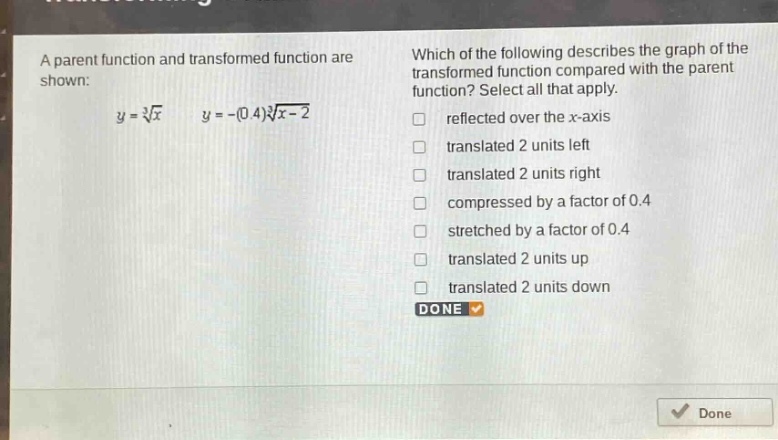
a parent function and transformed function are shown: (y = sqrt3{x}) (y=-(0.4)sqrt3{x - 2}) which of the following describes the graph of the transformed function compared with the parent function? select all that apply. reflected over the x - axis translated 2 units left translated 2 units right compressed by a factor of 0.4 stretched by a factor of 0.4 translated 2 units up translated 2 units down done
Answer
Explanation:
Step1: Analizar la reflexión
El signo negativo delante de la función transformada $y =-(0.4)\sqrt[3]{x - 2}$ con respecto a la función padre $y=\sqrt[3]{x}$ significa que la gráfica está reflejada sobre el eje $x$.
Step2: Analizar la traslación horizontal
En la función transformada $y =-(0.4)\sqrt[3]{x - 2}$, el valor de $x$ se cambia a $x - 2$. Según la regla de traslación horizontal $y = f(x - h)$ se traslada $h$ unidades a la derecha. Aquí $h = 2$, entonces está trasladada 2 unidades a la derecha.
Step3: Analizar la compresión/estiramiento
El factor 0.4 delante de la raíz cúbica significa que la gráfica está comprimida verticalmente por un factor de 0.4.
Answer:
- reflected over the x - axis
- translated 2 units right
- compressed by a factor of 0.4