the parent function $f(x)=1.5^{x}$ is translated such that the function $g(x)=1.5^{x + 1}+2$ represents the…
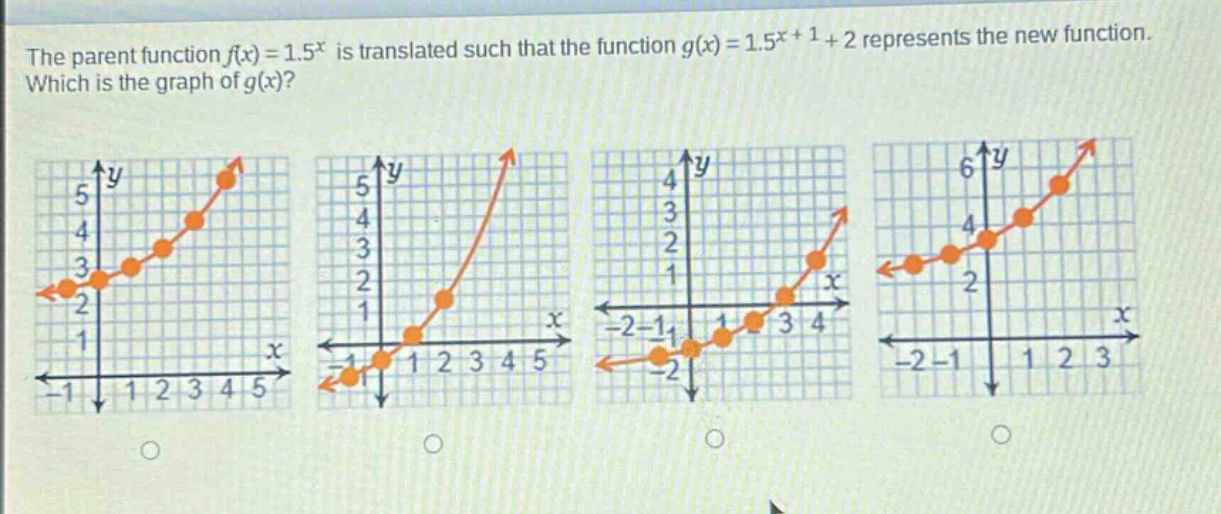
the parent function $f(x)=1.5^{x}$ is translated such that the function $g(x)=1.5^{x + 1}+2$ represents the new function. which is the graph of $g(x)$?
Answer
Explanation:
Step1: Analyze horizontal translation
For the function $g(x)=1.5^{x + 1}+2$, compared with the parent - function $y = a^{x}$ (here $a = 1.5$), the transformation $x\to x + 1$ means a horizontal shift to the left by 1 unit.
Step2: Analyze vertical translation
The $+2$ outside the exponential function means a vertical shift upwards by 2 units.
Step3: Consider the y - intercept
For the parent function $f(x)=1.5^{x}$, when $x = 0$, $f(0)=1.5^{0}=1$. For the function $g(x)=1.5^{x + 1}+2$, when $x = 0$, $g(0)=1.5^{0 + 1}+2=1.5+2 = 3.5$.
Step4: Consider the general shape of an exponential function
The general form of an exponential function $y = a^{x}$ with $a>1$ (here $a = 1.5$) is an increasing function. The function $g(x)=1.5^{x + 1}+2$ is also an increasing function.
The graph of $g(x)$ has a y - intercept of 3.5 and is an increasing exponential function that is shifted 1 unit to the left and 2 units up compared to $y = 1.5^{x}$.
Answer:
The graph that has a y - intercept around 3.5, is increasing, and has been shifted left and up compared to the basic exponential growth graph of $y = 1.5^{x}$. Without specific labels on the given graphs, based on the above - mentioned characteristics, you can identify the correct one among them.