the partial factorization of x² - x - 12 is modeled with algebra tiles. which unit tiles are needed to…
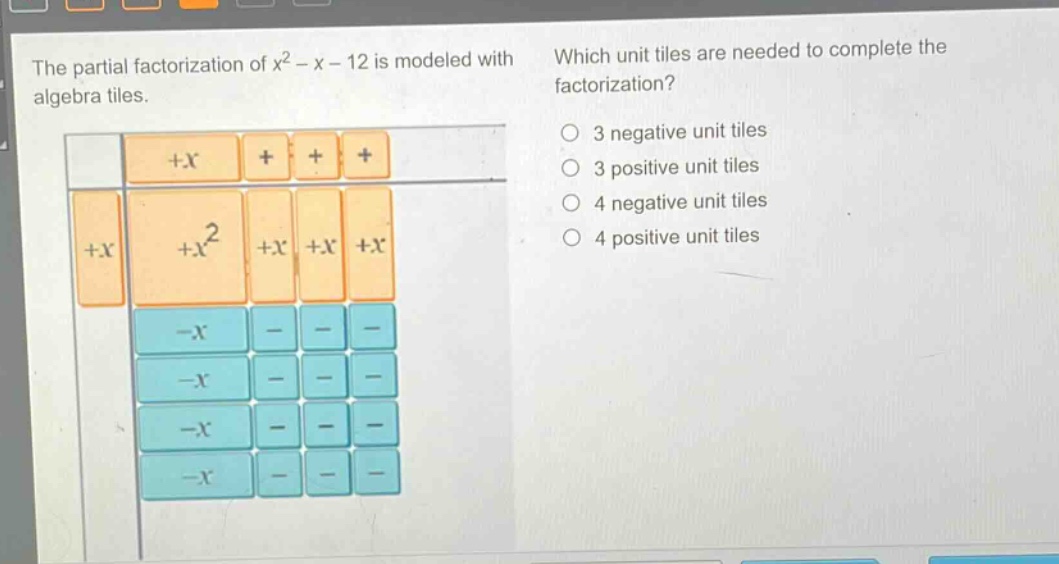
the partial factorization of x² - x - 12 is modeled with algebra tiles. which unit tiles are needed to complete the factorization? 3 negative unit tiles 3 positive unit tiles 4 negative unit tiles 4 positive unit tiles
Answer
Explanation:
Step1: Factor the quadratic expression
We factor (x^{2}-x - 12) using the formula (x^{2}+bx + c=(x + m)(x + n)) where (m\times n=c) and (m + n=b). For (x^{2}-x - 12), we need two numbers (m) and (n) such that (m\times n=- 12) and (m + n=-1). The numbers are (m = 3) and (n=-4), so (x^{2}-x - 12=(x + 3)(x-4)).
Step2: Analyze the algebra - tile model
The given partial - factorization shows part of the rectangle formed by the factors. The product of the binomials ((x + 3)(x - 4)=x\times x+3x-4x-12=x^{2}-x - 12). The existing tiles represent part of the expansion. We are missing the product of the non - (x) terms of the binomials. The product of the constants in ((x + 3)(x - 4)) gives the constant term of the quadratic. We already have some negative unit tiles, but we need to complete the product. The constant term of the factored form ((x + 3)(x - 4)) is (3\times(-4)=-12). Counting the existing negative unit tiles, we find that we need 4 negative unit tiles to complete the factorization.
Answer:
4 negative unit tiles