why is partitioning a directed line segment into a ratio of 1:3 not the same as finding $\frac{1}{3}$ the…
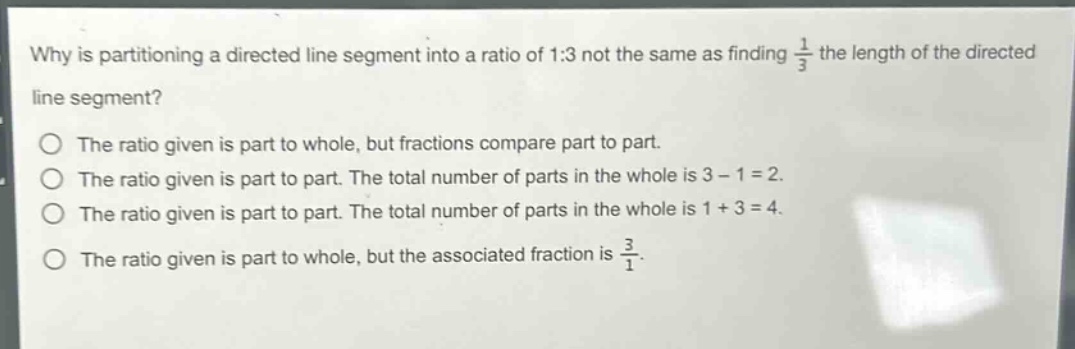
why is partitioning a directed line segment into a ratio of 1:3 not the same as finding $\frac{1}{3}$ the length of the directed line segment?\nthe ratio given is part to whole, but fractions compare part to part.\nthe ratio given is part to part. the total number of parts in the whole is 3 - 1 = 2.\nthe ratio given is part to part. the total number of parts in the whole is 1 + 3 = 4.\nthe ratio given is part to whole, but the associated fraction is $\frac{3}{1}$.
Answer
Brief Explanations:
A ratio of 1:3 is part - to - part. When we consider the whole, we add the parts of the ratio. So the total number of parts in the whole is 1 + 3=4. When we find 1/3 of the length of a directed line segment, we are using a part - to - whole relationship where the whole is divided into 3 equal parts and we take 1 of them. The two concepts are different because in the 1:3 ratio, the whole is divided into 4 parts.
Answer:
The ratio given is part to part. The total number of parts in the whole is 1 + 3 = 4.