if this pattern continues, how many squares will be in the 10th figure?\na. 14\nb. 20\nc. 26\nd. 29\ne. 32
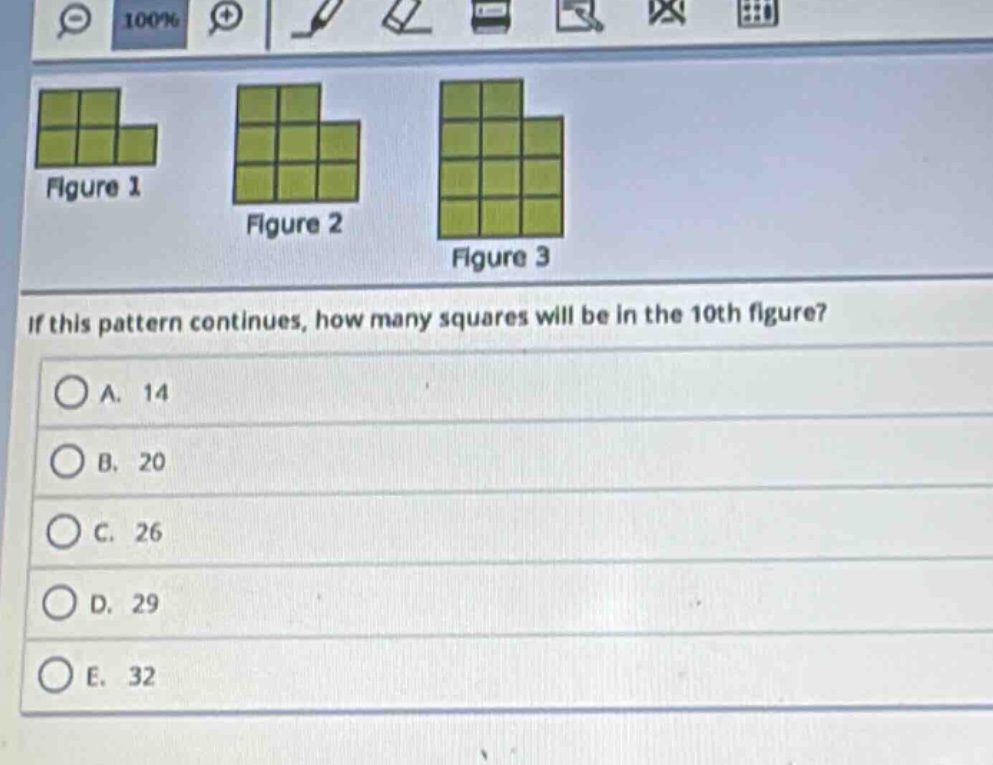
if this pattern continues, how many squares will be in the 10th figure?\na. 14\nb. 20\nc. 26\nd. 29\ne. 32
Answer
Explanation:
Step1: Analyze the pattern
Figure 1 has 5 squares ($3 + 2$), Figure 2 has 8 squares ($6+ 2$), Figure 3 has 11 squares ($9 + 2$). The number of squares in the non - additional part forms an arithmetic sequence with first term $a_1 = 3$ and common difference $d = 3$, and there are always 2 additional squares.
Step2: Find the formula for the number of squares in the $n$th figure
The formula for the $n$th term of an arithmetic sequence is $a_n=a_1+(n - 1)d$. Here, the number of squares in the non - additional part is $3+(n - 1)\times3=3n$. The total number of squares $S_n$ in the $n$th figure is $S_n=3n + 2$.
Step3: Calculate the number of squares in the 10th figure
Substitute $n = 10$ into the formula $S_n=3n + 2$. So $S_{10}=3\times10+ 2=30 + 2=32$.
Answer:
E. 32