the pattern of numbers below is an arithmetic sequence: 14, 24, 34, 44, 54, ... which statement describes…
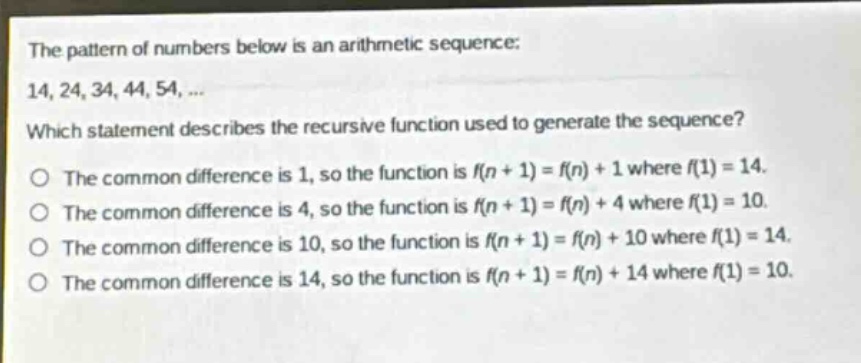
the pattern of numbers below is an arithmetic sequence: 14, 24, 34, 44, 54, ... which statement describes the recursive function used to generate the sequence? the common difference is 1, so the function is f(n + 1) = f(n) + 1 where f(1) = 14. the common difference is 4, so the function is f(n + 1) = f(n) + 4 where f(1) = 10. the common difference is 10, so the function is f(n + 1) = f(n) + 10 where f(1) = 14. the common difference is 14, so the function is f(n + 1) = f(n) + 14 where f(1) = 10.
Answer
Explanation:
Step1: Find the common - difference
Subtract the first term from the second term: $24 - 14=10$.
Step2: Recall the form of a recursive arithmetic - sequence function
The general form of a recursive function for an arithmetic sequence is $f(n + 1)=f(n)+d$, where $d$ is the common difference and $f(1)$ is the first term. Here, $d = 10$ and $f(1)=14$, so the function is $f(n + 1)=f(n)+10$ where $f(1)=14$.
Answer:
The common difference is 10, so the function is $f(n + 1)=f(n)+10$ where $f(1)=14$.