penelope went to the store to buy x pounds of broccoli for $1.10 per pound and y cans of soup for $2.50…
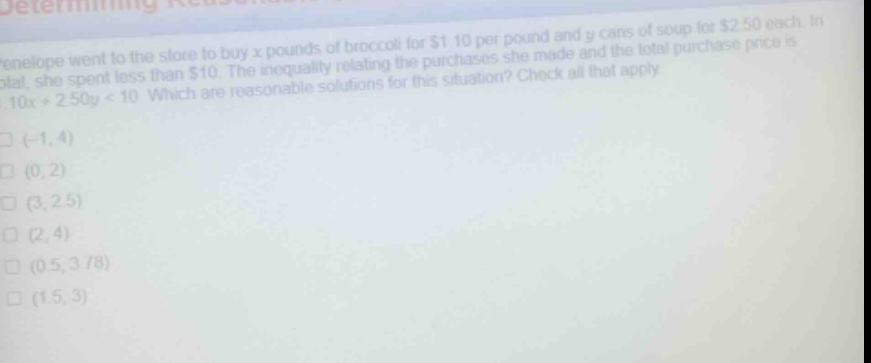
penelope went to the store to buy x pounds of broccoli for $1.10 per pound and y cans of soup for $2.50 each. in total, she spent less than $10. the inequality relating the purchases she made and the total purchase price is 1.10x + 2.50y < 10. which are reasonable solutions for this situation? check all that apply.\n(-1, 4)\n(0, 2)\n(3, 2.5)\n(2, 4)\n(0.5, 3.78)\n(1.5, 3)
Answer
Explanation:
Step1: Recall the domain of variables
The amounts of broccoli and soup (x and y) cannot be negative since they represent quantities of items bought. So we can immediately rule out any solution with a negative - valued coordinate.
Step2: Substitute each non - negative pair into the inequality
The inequality is (1.0x + 2.5y<10). For the pair ((0,2)): Substitute (x = 0) and (y = 2) into the inequality: (1\times0+2.5\times2=0 + 5=5<10), so ((0,2)) is a solution. For the pair ((0.5,3.78)): Substitute (x = 0.5) and (y = 3.78) into the inequality: (1\times0.5+2.5\times3.78=0.5 + 9.45 = 9.95<10), so ((0.5,3.78)) is a solution. For the pair ((1.5,3)): Substitute (x = 1.5) and (y = 3) into the inequality: (1\times1.5+2.5\times3=1.5 + 7.5=9<10), so ((1.5,3)) is a solution. For the pair ((3,2.5)): Substitute (x = 3) and (y = 2.5) into the inequality: (1\times3+2.5\times2.5=3 + 6.25 = 9.25<10), so ((3,2.5)) is a solution. For the pair ((2,4)): Substitute (x = 2) and (y = 4) into the inequality: (1\times2+2.5\times4=2 + 10=12>10), so ((2,4)) is not a solution.
Answer:
((0,2)), ((3,2.5)), ((0.5,3.78)), ((1.5,3))