the perimeter of the rectangle shown is 76 cm. it is rotated about line b. which best describes the…
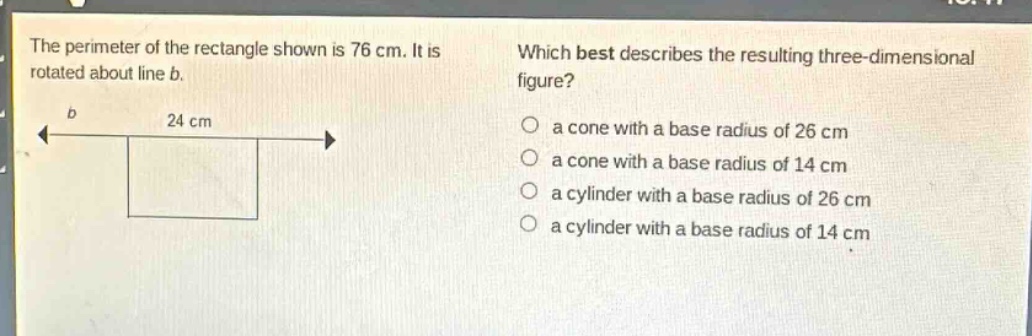
the perimeter of the rectangle shown is 76 cm. it is rotated about line b. which best describes the resulting three - dimensional figure? a cone with a base radius of 26 cm a cone with a base radius of 14 cm a cylinder with a base radius of 26 cm a cylinder with a base radius of 14 cm
Answer
Explanation:
Step1: Find the width of the rectangle
Let the length of the rectangle be $l = 24$ cm and the width be $w$. The perimeter formula of a rectangle is $P=2(l + w)$. Given $P = 76$ cm. So, $76=2(24 + w)$. First, divide both sides by 2: $\frac{76}{2}=24 + w$, which gives $38=24 + w$. Then subtract 24 from both sides: $w=38 - 24=14$ cm.
Step2: Determine the three - dimensional figure
When a rectangle is rotated about a line parallel to one of its sides, the resulting three - dimensional figure is a cylinder. The side perpendicular to the axis of rotation becomes the radius of the base of the cylinder. Here, the width of the rectangle ($14$ cm) is the radius of the base of the resulting cylinder.
Answer:
a cylinder with a base radius of 14 cm