a person rides a bicycle for $1\frac{1}{3}$ hours on tuesday, $2\frac{1}{4}$ hours on thursday and…
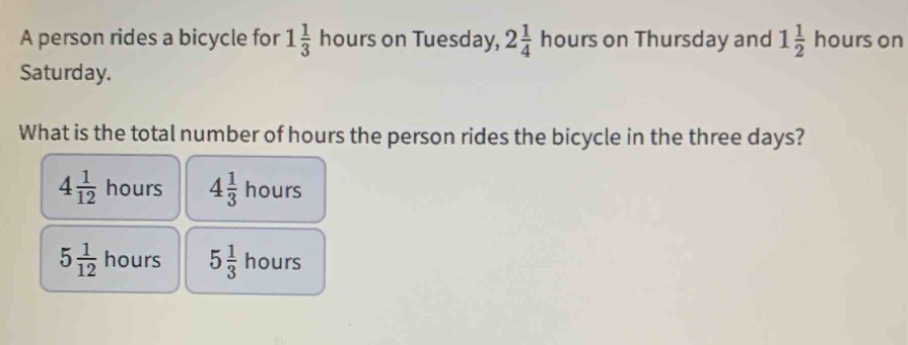
a person rides a bicycle for $1\frac{1}{3}$ hours on tuesday, $2\frac{1}{4}$ hours on thursday and $1\frac{1}{2}$ hours on saturday. what is the total number of hours the person rides the bicycle in the three days? $4\frac{1}{12}$ hours $4\frac{1}{3}$ hours $5\frac{1}{12}$ hours $5\frac{1}{3}$ hours
Answer
Explanation:
Step1: Convert mixed - numbers to improper fractions
$1\frac{1}{3}=\frac{1\times3 + 1}{3}=\frac{4}{3}$, $2\frac{1}{4}=\frac{2\times4+1}{4}=\frac{9}{4}$, $1\frac{1}{2}=\frac{1\times2 + 1}{2}=\frac{3}{2}$
Step2: Find a common denominator
The least common multiple of 3, 4, and 2 is 12.
Step3: Rewrite fractions with the common denominator
$\frac{4}{3}=\frac{4\times4}{3\times4}=\frac{16}{12}$, $\frac{9}{4}=\frac{9\times3}{4\times3}=\frac{27}{12}$, $\frac{3}{2}=\frac{3\times6}{2\times6}=\frac{18}{12}$
Step4: Add the fractions
$\frac{16}{12}+\frac{27}{12}+\frac{18}{12}=\frac{16 + 27+18}{12}=\frac{61}{12}$
Step5: Convert the improper fraction back to a mixed - number
$\frac{61}{12}=5\frac{1}{12}$
Answer:
$5\frac{1}{12}$ hours