planes m and n intersect at line d. line a forms a right angle with line d. line b is diagonal and crosses…
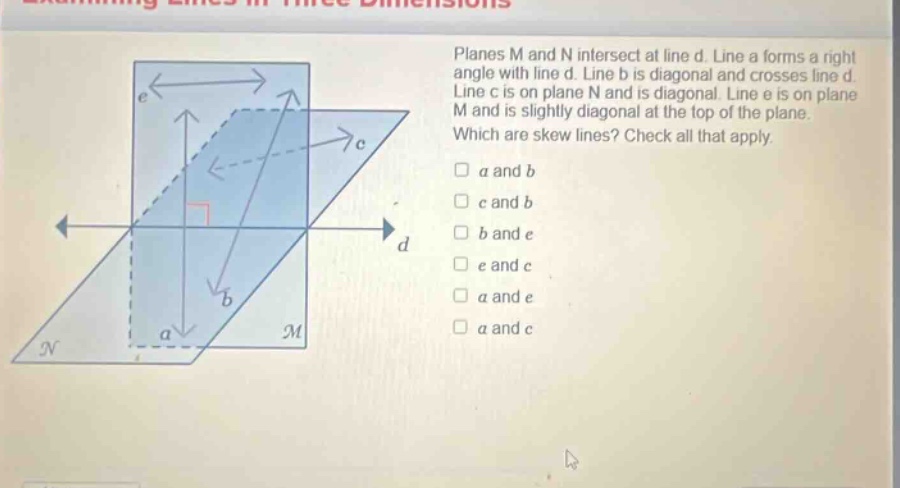
planes m and n intersect at line d. line a forms a right angle with line d. line b is diagonal and crosses line d. line c is on plane n and is diagonal. line e is on plane m and is slightly diagonal at the top of the plane. which are skew lines? check all that apply. a and b c and b b and e e and c a and e a and c
Answer
Explanation:
Step1: Recall skew - lines definition
Skew lines are non - parallel and non - intersecting lines in 3 - D space.
Step2: Analyze each pair
- For (a) and (b): Line (a) and line (b) intersect at a point on line (d), so they are not skew.
- For (c) and (b): Line (c) and line (b) are in different planes and do not intersect and are not parallel, so they are skew.
- For (b) and (e): Line (b) and line (e) are in the same plane (M), so they are not skew.
- For (e) and (c): Line (e) is in plane (M) and line (c) is in plane (N), they do not intersect and are not parallel, so they are skew.
- For (a) and (e): Line (a) and line (e) are in the same plane (M), so they are not skew.
- For (a) and (c): Line (a) is perpendicular to line (d) and line (c) is in plane (N), they do not intersect and are not parallel, so they are skew.
Answer:
c and b, e and c, a and c