planes q and r are parallel planes. plane q contains line a. plane r contains line b. if a third plane could…
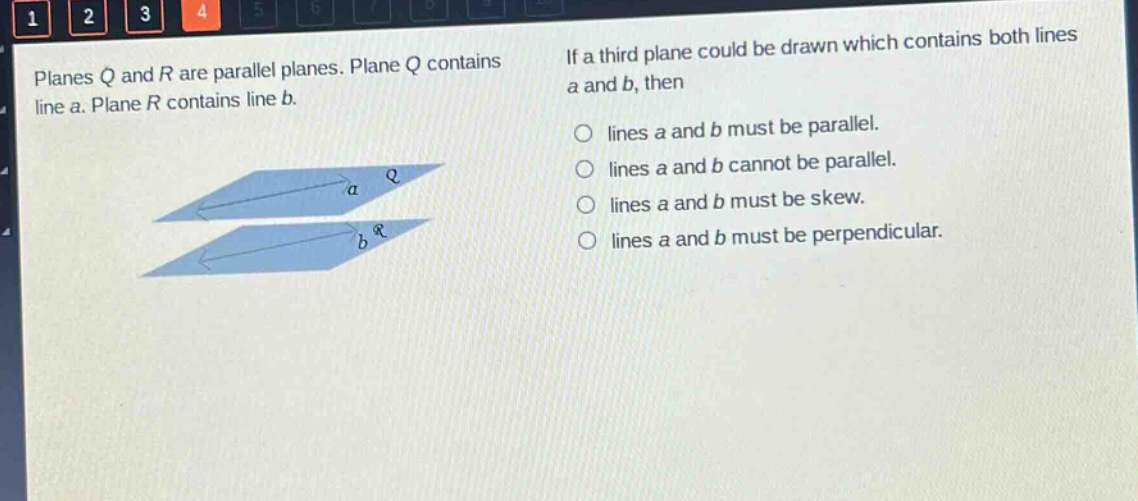
planes q and r are parallel planes. plane q contains line a. plane r contains line b. if a third plane could be drawn which contains both lines a and b, then\nlines a and b must be parallel.\nlines a and b cannot be parallel.\nlines a and b must be skew.\nlines a and b must be perpendicular.
Answer
Brief Explanations:
If two lines lie in the same plane, they are coplanar. Given parallel planes Q and R with line a in Q and line b in R, if a third - plane can contain both a and b, then a and b must be parallel as skew lines are non - coplanar and perpendicular lines are a special case of non - parallel coplanar lines.
Answer:
lines a and b must be parallel.