8. to play a game, a number cube with sides numbered 1 through 6 is rolled and a fair coin is flipped. use a…
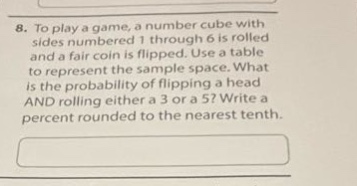
8. to play a game, a number cube with sides numbered 1 through 6 is rolled and a fair coin is flipped. use a table to represent the sample space. what is the probability of flipping a head and rolling either a 3 or a 5? write a percent rounded to the nearest tenth.
Answer
Explanation:
Step1: Determine the total number of outcomes
The number of outcomes when rolling a number cube is (n_{cube}=6) (since the cube has 6 sides numbered 1 - 6). The number of outcomes when flipping a coin is (n_{coin}=2) (head or tail). By the fundamental counting principle, the total number of outcomes in the sample space (n = n_{cube}\times n_{coin}=6\times2 = 12).
Step2: Determine the number of favorable outcomes
The favorable outcomes are (H, 3) and (H, 5). So the number of favorable outcomes (m = 2).
Step3: Calculate the probability
The probability formula is (P=\frac{m}{n}). Substituting (m = 2) and (n=12), we get (P=\frac{2}{12}=\frac{1}{6}).
Step4: Convert the probability to a percentage
To convert (\frac{1}{6}) to a percentage, we use the formula (P(%)=\frac{1}{6}\times100%). (P(%)=\frac{100}{6}% \approx 16.7%)
Answer:
(16.7%)