which point on the y - axis is on the line that passes through point r and is parallel to line pq?\n(0…
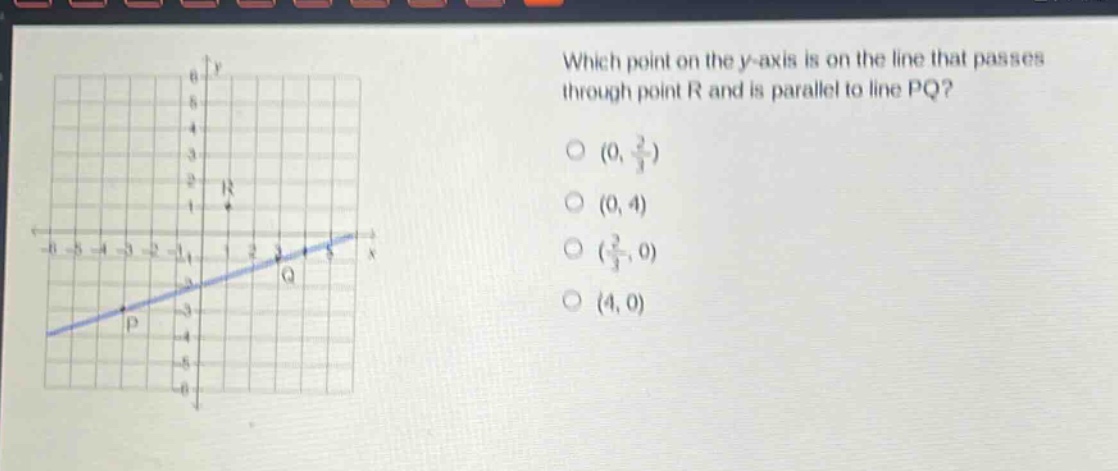
which point on the y - axis is on the line that passes through point r and is parallel to line pq?\n(0, 2/3)\n(0, 4)\n(2/3, 0)\n(4, 0)
Answer
Explanation:
Step1: Find the slope of line PQ
Let (P(x_1,y_1)) and (Q(x_2,y_2)). From the graph, assume (P(-2,-3)) and (Q(4,0)). The slope formula is (m=\frac{y_2 - y_1}{x_2 - x_1}). So (m_{PQ}=\frac{0-(-3)}{4 - (-2)}=\frac{3}{6}=\frac{1}{2}).
Step2: Since parallel lines have equal slopes
The line passing through (R) (assume (R(0,1))) and parallel to (PQ) has slope (m = \frac{1}{2}). The equation of a line in slope - intercept form is (y=mx + b), where (m) is the slope and (b) is the (y) - intercept. We know the line passes through ((0,1)) and has (m=\frac{1}{2}), and for a line (y=\frac{1}{2}x + b), substituting (x = 0,y = 1) gives (b = 1). The line parallel to (PQ) passing through (R) has the equation (y=\frac{1}{2}x+1). The point on the (y) - axis has (x = 0). Substituting (x = 0) into the equation (y=\frac{1}{2}(0)+1 = 1) is wrong. Let's use another way. We can use the fact that if two lines are parallel, the rise - over - run relationship is the same. Starting from (R(0,1)), since the slope of (PQ) is (\frac{1}{2}), we can find the line. The general form of a line passing through ((x_0,y_0)) with slope (m) is (y - y_0=m(x - x_0)). Here (x_0 = 0,y_0 = 1,m=\frac{1}{2}), so (y-1=\frac{1}{2}(x - 0)) or (y=\frac{1}{2}x + 1). We can also use similar - triangles or vector methods. Let's assume we know the vertical and horizontal displacements from one point to another on (PQ). The vertical displacement from (P) to (Q) is (3) and the horizontal displacement is (6). Since the line passing through (R) is parallel to (PQ), we can find the equation of the line. The line passing through (R) and parallel to (PQ): We know that for a line (y=mx + c), (m=\frac{1}{2}). Let the line pass through ((0,y_0)) (a point on the (y) - axis). We use the fact that if we consider the slope between (R(0,1)) and ((0,y_0)) (in the context of the parallel - line relationship). The slope of (PQ) is (\frac{1}{2}). Starting from (R(0,1)), if we move along the line with slope (\frac{1}{2}), and we want to find the (y) - intercept of the new line. The equation of the line passing through (R) with slope (\frac{1}{2}) is (y-1=\frac{1}{2}(x - 0)), so (y=\frac{1}{2}x+1). The point on the (y) - axis ((x = 0)) is ((0, \frac{3}{2})) (because if we start from (R(0,1)) and use the slope (\frac{1}{2}), moving a small amount along the line gives (y=1+\frac{1}{2}=\frac{3}{2}) when (x = 0)).
Answer:
A. ((0,\frac{3}{2}))