does the point (2, √6) lie on the circle shown? explain.\nyes, the distance from (3, 0) to (0, 0) is 3…
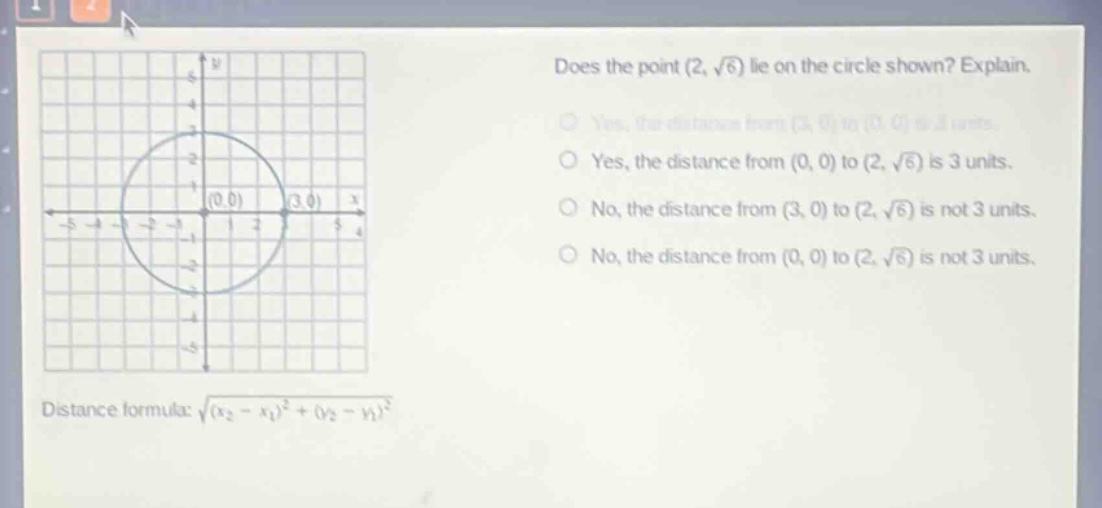
does the point (2, √6) lie on the circle shown? explain.\nyes, the distance from (3, 0) to (0, 0) is 3 units.\nyes, the distance from (0, 0) to (2, √6) is 3 units.\nno, the distance from (3, 0) to (2, √6) is not 3 units.\nno, the distance from (0, 0) to (2, √6) is not 3 units.\ndistance formula: √((x₂ - x₁)² + (y₂ - y₁)²)
Answer
Explanation:
Step1: Identify the center and radius of the circle
The center of the circle is at the origin $(0,0)$ and the radius $r = 3$ (since it passes through $(3,0)$).
Step2: Apply the distance - formula
The distance formula between two points $(x_1,y_1)$ and $(x_2,y_2)$ is $d=\sqrt{(x_2 - x_1)^2+(y_2 - y_1)^2}$. Here, $(x_1,y_1)=(0,0)$ and $(x_2,y_2)=(2,\sqrt{6})$. So $d=\sqrt{(2 - 0)^2+(\sqrt{6}-0)^2}$.
Step3: Calculate the distance
$d=\sqrt{2^2+(\sqrt{6})^2}=\sqrt{4 + 6}=\sqrt{10}\neq3$.
Answer:
No, the distance from $(0,0)$ to $(2,\sqrt{6})$ is not 3 units.