point b is the mid - point of $overline{ac}$. which statements about the figure must be true? select three…
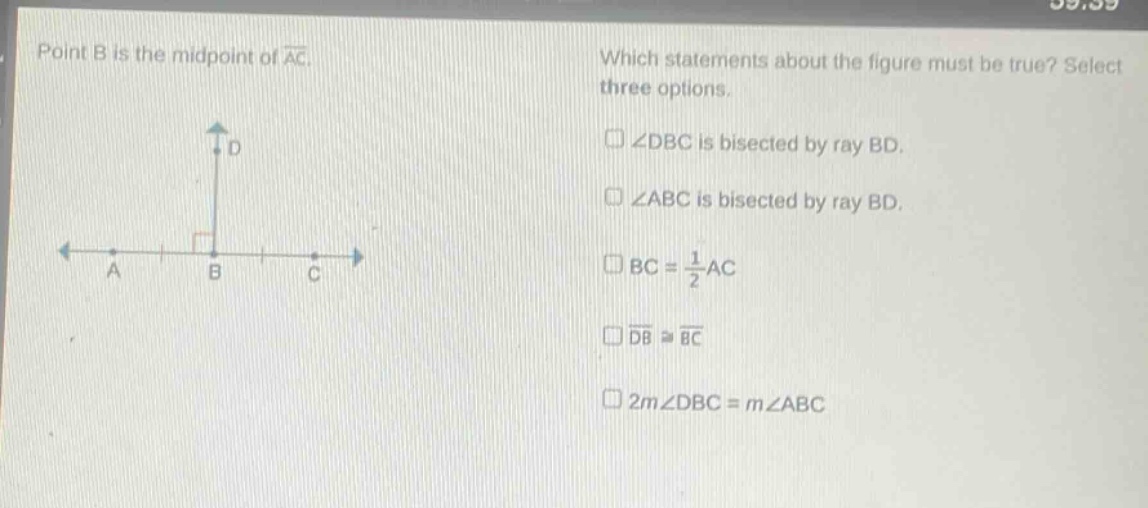
point b is the mid - point of $overline{ac}$. which statements about the figure must be true? select three options. $squareangle dbc$ is bisected by ray bd. $squareangle abc$ is bisected by ray bd. $square bc=\frac{1}{2}ac$ $squareoverline{db}congoverline{bc}$ $square2mangle dbc = mangle abc$
Answer
Explanation:
Step1: Analyze Given Information and Diagram
Point B is the midpoint of $\overline{AC}$. This implies $AB = BC$ and $AC = AB + BC$. The diagram shows that ray $BD$ is perpendicular to line $AC$ at point B, so $m\angle ABD = 90^\circ$ and $m\angle DBC = 90^\circ$. Points A, B, and C are collinear, forming a straight line, so $\angle ABC$ is a straight angle, meaning $m\angle ABC = 180^\circ$.
Step2: Evaluate "$\angle DBC$ is bisected by ray $BD$."
Ray $BD$ is one of the sides that form $\angle DBC$. An angle bisector must be a ray in the interior of the angle, dividing it into two congruent angles. Therefore, ray $BD$ cannot bisect $\angle DBC$. This statement is false.
Step3: Evaluate "$\angle ABC$ is bisected by ray $BD$."
$\angle ABC$ is a straight angle, so $m\angle ABC = 180^\circ$. Ray $BD$ divides $\angle ABC$ into $\angle ABD$ and $\angle DBC$. Since $BD \perp AC$, $m\angle ABD = 90^\circ$ and $m\angle DBC = 90^\circ$. As $m\angle ABD = m\angle DBC = 90^\circ$, ray $BD$ divides $\angle ABC$ into two equal angles. Thus, ray $BD$ bisects $\angle ABC$. This statement is true.
Step4: Evaluate "$BC = \frac{1}{2}AC$."
Since B is the midpoint of $\overline{AC}$, it divides $\overline{AC}$ into two equal segments, $AB$ and $BC$. So, $AB = BC$. The length of $\overline{AC}$ is the sum of the lengths of $\overline{AB}$ and $\overline{BC}$: $AC = AB + BC$. Substituting $AB = BC$ gives $AC = BC + BC = 2BC$. Dividing by 2, we get $BC = \frac{1}{2}AC$. This statement is true.
Step5: Evaluate "$\overline{DB} \cong \overline{BC}$."
This statement means that the length of segment $DB$ is equal to the length of segment $BC$ ($DB = BC$). While $BD \perp AC$, there is no information given that relates the length of $DB$ to the length of $BC$. The length of $DB$ can be any positive value and is not necessarily equal to $BC$. This statement is not necessarily true.
Step6: Evaluate "$2m\angle DBC = m\angle ABC$."
From Step 1, $m\angle DBC = 90^\circ$ (since $BD \perp AC$). From Step 1, $m\angle ABC = 180^\circ$ (since $\angle ABC$ is a straight angle). Substitute these values into the equation: $2 \times (90^\circ) = 180^\circ$. This simplifies to $180^\circ = 180^\circ$, which is true. This statement is true.
Answer:
The three statements that must be true are: $\angle ABC$ is bisected by ray $BD$. $BC = \frac{1}{2}AC$ $2m\angle DBC = m\angle ABC$