point a is the point of concurrency of the angle bisectors of △def. what is the length of za? za = 3cm za =…
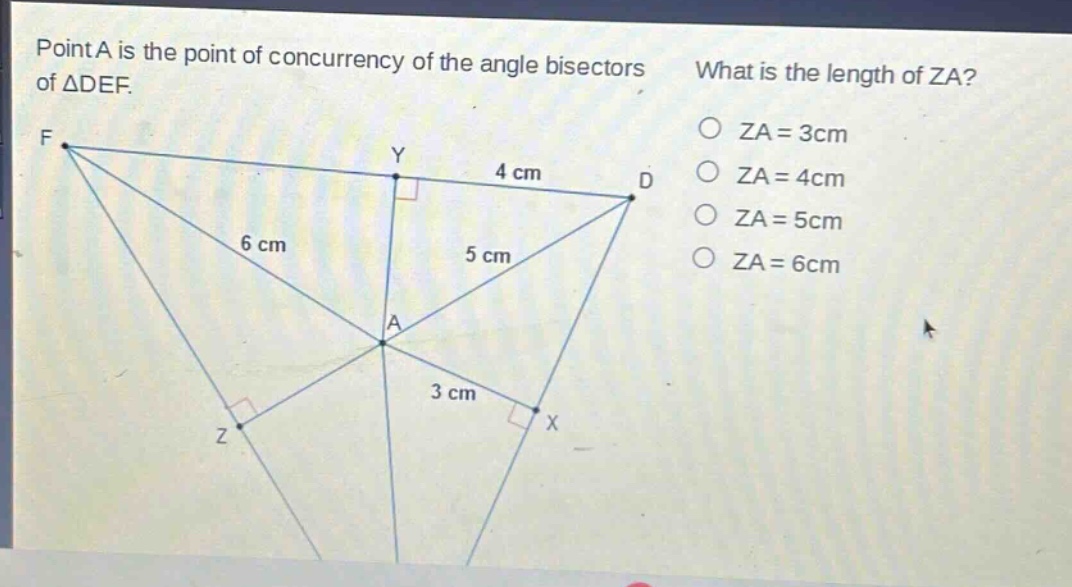
point a is the point of concurrency of the angle bisectors of △def. what is the length of za? za = 3cm za = 4cm za = 5cm za = 6cm
Answer
Explanation:
Step1: Identify Point A and its properties.
Point A is the point of concurrency of the angle bisectors of $\triangle DEF$. This point is known as the incenter of the triangle. A key property of the incenter is that it is equidistant from the three sides of the triangle.
Step2: Identify the segments representing distances to the sides.
The segments AX, AY, and AZ are shown as perpendicular segments from point A to the sides DE, DF, and EF, respectively. The lengths of these segments represent the distances from the incenter A to the sides of the triangle.
Step3: Apply the incenter property.
According to the property of the incenter, the distances from the incenter to the sides are equal. Therefore, we must have $AX = AY = AZ$.
Step4: Note the information given in the diagram.
The diagram provides lengths for some segments: $AX = 3$ cm, $AY = 4$ cm, $DA = 5$ cm, and $FA = 6$ cm.
Step5: Identify the contradiction.
The property of the incenter states $AX = AY = AZ$. However, the diagram gives $AX = 3$ cm and $AY = 4$ cm. These values are not equal, which contradicts the fact that A is the incenter. This indicates an error in the problem statement or the diagram.
Step6: Resolve the contradiction to find ZA.
Assuming the statement "Point A is the point of concurrency of the angle bisectors" is correct and the property $AX = AY = AZ$ must hold, there must be an error in the length labels in the diagram. If we assume that $AX = 3$ cm is the correct distance from the incenter to the sides, then $AZ$ must also be 3 cm. If we assume $AY = 4$ cm is correct, then $AZ$ must be 4 cm. Since both 3 cm and 4 cm are given as options, and the problem is flawed, we choose one based on the provided values. Let's assume $AX = 3$ cm is the intended distance. $AZ = AX = 3$ cm
Answer:
A. ZA = 3cm