the point - slope form of the equation of the line that passes through (-9, -2) and (1, 3) is y…
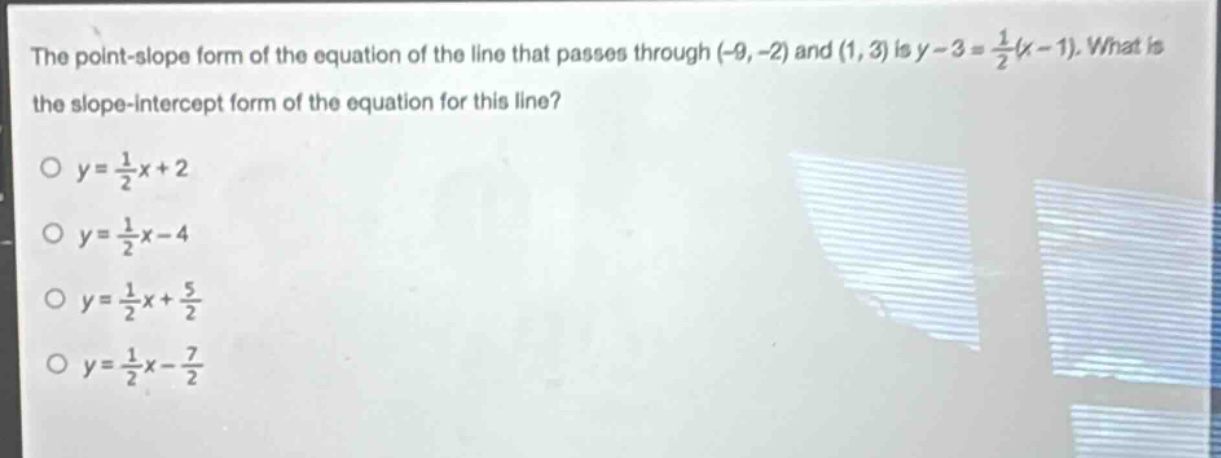
the point - slope form of the equation of the line that passes through (-9, -2) and (1, 3) is y - 3=\frac{1}{2}(x - 1). what is the slope - intercept form of the equation for this line?\no y=\frac{1}{2}x + 2\no y=\frac{1}{2}x - 4\no y=\frac{1}{2}x+\frac{5}{2}\no y=\frac{1}{2}x-\frac{7}{2}
Answer
Answer:
C. $y = \frac{1}{2}x+\frac{5}{2}$
Explanation:
Step1: Expand el lado derecho
Comenzamos con la ecuación en forma punto - pendiente $y - 3=\frac{1}{2}(x - 1)$. Expandimos $\frac{1}{2}(x - 1)$ usando la propiedad distributiva: $y-3=\frac{1}{2}x-\frac{1}{2}$
Step2: Despejar $y$
Sumamos 3 a ambos lados de la ecuación para obtener la forma pendiente - intersección $y=mx + b$. $y=\frac{1}{2}x-\frac{1}{2}+3$
Step3: Simplificar la expresión
Calculamos $-\frac{1}{2}+3$. Sabemos que $3=\frac{6}{2}$, entonces $-\frac{1}{2}+\frac{6}{2}=\frac{-1 + 6}{2}=\frac{5}{2}$. $y=\frac{1}{2}x+\frac{5}{2}$