which point is a solution to the linear inequality y < -\\frac{1}{2}x + 2?\n(2, 3)\n(2, 1)\n(3, -2)\n(-1, 3)
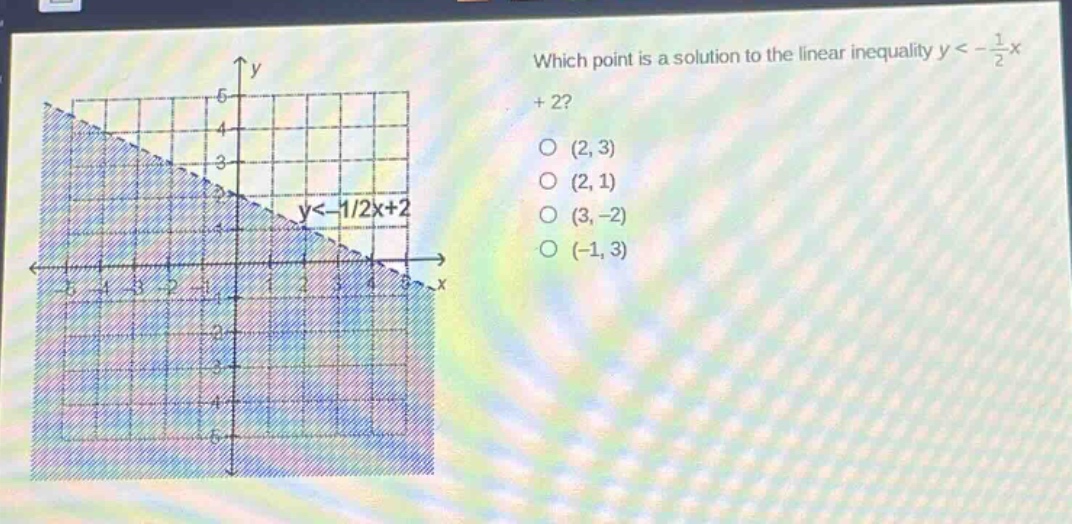
which point is a solution to the linear inequality y < -\\frac{1}{2}x + 2?\n(2, 3)\n(2, 1)\n(3, -2)\n(-1, 3)
Answer
Explanation:
Step1: Substitute point (2, 3)
Substitute (x = 2) and (y=3) into (y<-\frac{1}{2}x + 2). We get (3<-\frac{1}{2}\times2+2), which simplifies to (3< - 1 + 2), or (3<1), false.
Step2: Substitute point (2, 1)
Substitute (x = 2) and (y = 1) into (y<-\frac{1}{2}x+2). We get (1<-\frac{1}{2}\times2 + 2), which simplifies to (1< - 1+2), or (1<1), false.
Step3: Substitute point (3, - 2)
Substitute (x = 3) and (y=-2) into (y<-\frac{1}{2}x + 2). We get (-2<-\frac{1}{2}\times3+2), which simplifies to (-2<-\frac{3}{2}+2), or (-2<\frac{1}{2}), true.
Step4: Substitute point (-1, 3)
Substitute (x=-1) and (y = 3) into (y<-\frac{1}{2}x+2). We get (3<-\frac{1}{2}\times(-1)+2), which simplifies to (3<\frac{1}{2}+2), or (3<\frac{5}{2}), false.
Answer:
C. ((3,-2))