the point $p(x,y)$ is on the terminal ray of angle $\theta$. if $\theta$ is between $pi$ radians and…
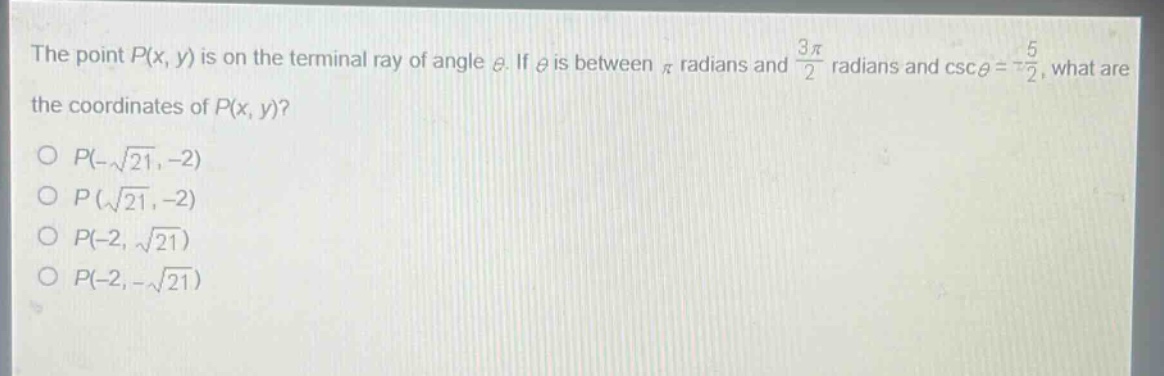
the point $p(x,y)$ is on the terminal ray of angle $\theta$. if $\theta$ is between $pi$ radians and $\frac{3pi}{2}$ radians and $csc\theta = -\frac{5}{2}$, what are the coordinates of $p(x,y)$?\n$p(-sqrt{21}, - 2)$\n$p(sqrt{21}, - 2)$\n$p(-2,sqrt{21})$\n$p(-2,-sqrt{21})$
Answer
Answer:
D. $P(-2,-\sqrt{21})$
Explanation:
Step1: Recall the definition of cosecant
We know that $\csc\theta=\frac{r}{y}$, and given $\csc\theta =-\frac{5}{2}$, so $r = 5$ and $y=-2$ (since $\csc\theta<0$ in the third - quadrant where $\pi<\theta<\frac{3\pi}{2}$).
Step2: Use the Pythagorean identity $x^{2}+y^{2}=r^{2}$
Substitute $r = 5$ and $y=-2$ into $x^{2}+y^{2}=r^{2}$. We get $x^{2}+(-2)^{2}=5^{2}$, which simplifies to $x^{2}+4 = 25$. Then $x^{2}=25 - 4=21$, so $x=\pm\sqrt{21}$.
Step3: Determine the sign of $x$
Since the angle $\theta$ is in the third - quadrant where $x<0$, so $x =-\sqrt{21}$. The coordinates of the point $P(x,y)$ are $(-2,-\sqrt{21})$.