what other points are on the line of direct variation through (5, 12)? check all that apply.\n(0, 0)\n(2.5…
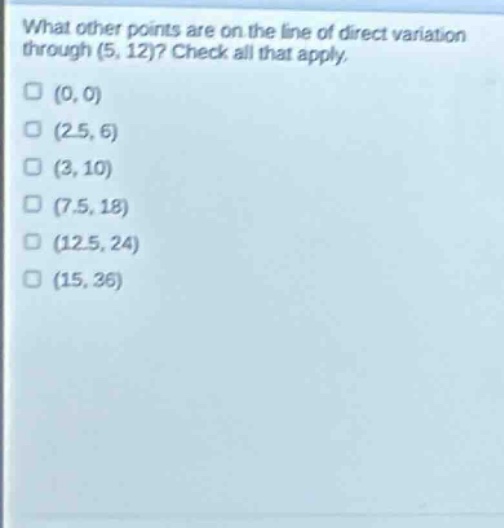
what other points are on the line of direct variation through (5, 12)? check all that apply.\n(0, 0)\n(2.5, 6)\n(3, 10)\n(7.5, 18)\n(12.5, 24)\n(15, 36)
Answer
Explanation:
Step1: Find the constant of variation (k).
A line of direct variation is given by $y = kx$. Using the point $(5, 12)$: $$12 = k \times 5$$ $$k = \frac{12}{5}$$
Step2: Write the equation of the line.
The equation of the line of direct variation is: $$y = \frac{12}{5}x$$
Step3: Check each point.
Check if each point $(x, y)$ satisfies the equation $y = \frac{12}{5}x$, or equivalently, if $\frac{y}{x} = \frac{12}{5}$ (for $x \neq 0$).
- (0, 0): Lines of direct variation pass through the origin. $0 = \frac{12}{5} \times 0$. True.
- (2.5, 6): $y = \frac{12}{5} \times 2.5 = \frac{12}{5} \times \frac{5}{2} = 6$. True.
- (3, 10): $y = \frac{12}{5} \times 3 = \frac{36}{5} = 7.2 \neq 10$. False.
- (7.5, 18): $y = \frac{12}{5} \times 7.5 = \frac{12}{5} \times \frac{15}{2} = \frac{180}{10} = 18$. True.
- (12.5, 24): $y = \frac{12}{5} \times 12.5 = \frac{12}{5} \times \frac{25}{2} = \frac{300}{10} = 30 \neq 24$. False.
- (15, 36): $y = \frac{12}{5} \times 15 = 12 \times 3 = 36$. True.
Answer:
(0, 0) (2.5, 6) (7.5, 18) (15, 36)