the polynomial equation $x^{6}-16x^{2}=4x^{4}-64$ has complex roots $pm2i$. what are the other roots? use a…
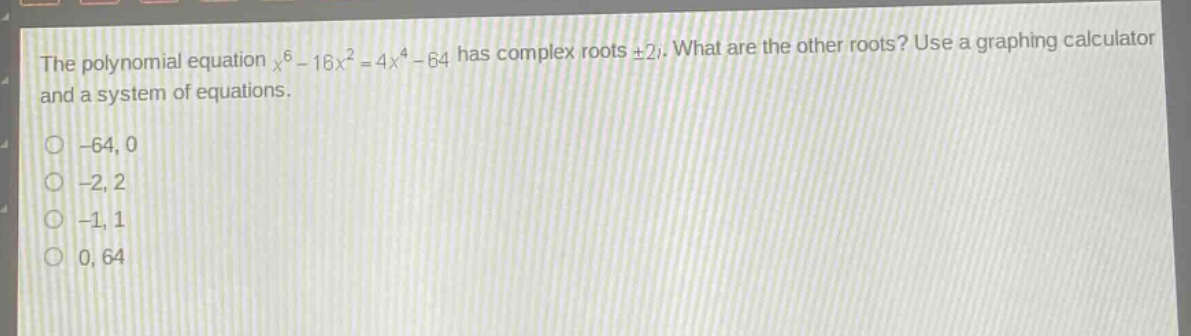
the polynomial equation $x^{6}-16x^{2}=4x^{4}-64$ has complex roots $pm2i$. what are the other roots? use a graphing calculator and a system of equations.\n-64, 0\n-2, 2\n-1, 1\n0, 64
Answer
Explanation:
Step1: Rearrange the equation
First, rewrite the equation $x^{6}-16x^{2}=4x^{4}-64$ as $x^{6}-4x^{4}-16x^{2}+64 = 0$.
Step2: Use substitution
Let $y = x^{2}$, then the equation becomes $y^{3}-4y^{2}-16y + 64=0$.
Step3: Factor by grouping
Group the terms: $(y^{3}-4y^{2})-(16y - 64)=0$. Factor out common factors from each group: $y^{2}(y - 4)-16(y - 4)=0$. Then $(y - 4)(y^{2}-16)=0$.
Step4: Further factor
Factor $y^{2}-16$ as a difference - of - squares: $(y - 4)(y - 4)(y + 4)=0$. So $y=4$ or $y=-4$.
Step5: Substitute back $x$
Since $y = x^{2}$, when $y = 4$, we have $x^{2}=4$, which gives $x=\pm2$. When $y=-4$, we have $x^{2}=-4$, which gives $x=\pm2i$.
Answer:
B. -2, 2