the polynomial equation $x^{3}-4x^{2}+2x + 10=x^{2}-5x - 3$ has complex roots $3pm2i$. what is the other…
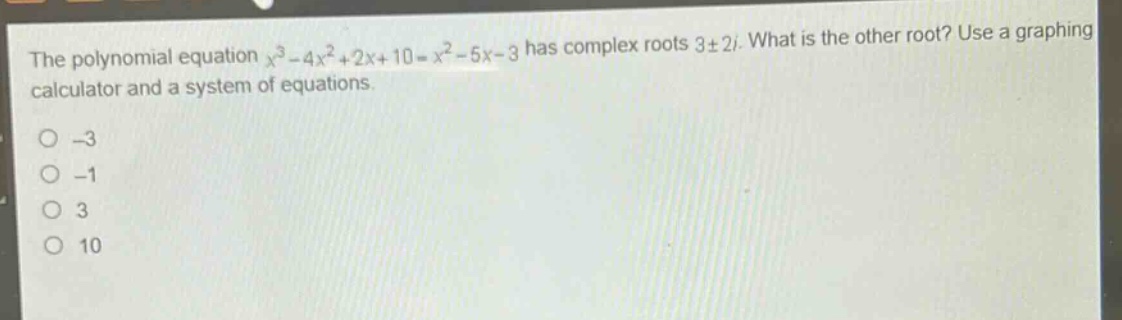
the polynomial equation $x^{3}-4x^{2}+2x + 10=x^{2}-5x - 3$ has complex roots $3pm2i$. what is the other root? use a graphing calculator and a system of equations.\n-3\n-1\n3\n10
Answer
Answer:
A. -3
Explanation:
Step1: Rearrange the polynomial
First, rewrite the equation (x^{3}-4x^{2}+2x + 10=x^{2}-5x - 3) as (x^{3}-5x^{2}+7x+13 = 0).
Step2: Recall conjugate - root theorem
For a polynomial with real - valued coefficients, if (a + bi) is a root, then its complex conjugate (a - bi) is also a root. Given roots are (3 + 2i) and (3 - 2i).
Step3: Form a quadratic factor
The quadratic factor corresponding to the roots (3\pm2i) is ((x-(3 + 2i))(x-(3 - 2i))). [ \begin{align*} (x-(3 + 2i))(x-(3 - 2i))&=(x - 3-2i)(x - 3 + 2i)\ &=(x - 3)^{2}-(2i)^{2}\ &=x^{2}-6x + 9+4\ &=x^{2}-6x+13 \end{align*} ]
Step4: Divide the polynomial
Divide (x^{3}-5x^{2}+7x + 13) by (x^{2}-6x + 13) using polynomial long - division or synthetic division. [ \begin{align*} x^{3}-5x^{2}+7x + 13&=(x^{2}-6x + 13)(x+1) \end{align*} ] Set (x + 1=0), we get (x=-1). But we can also use the fact that for a cubic polynomial (ax^{3}+bx^{2}+cx + d) with roots (r_1,r_2,r_3), (r_1 + r_2+r_3=-\frac{b}{a}). Here (a = 1), (b=-5), and (r_1=3 + 2i), (r_2=3 - 2i). Let the third root be (r_3). Then ((3 + 2i)+(3 - 2i)+r_3=5), (6+r_3=5), (r_3=-1). Another way is to substitute the given options into the polynomial (x^{3}-5x^{2}+7x + 13). When (x=-3): [ \begin{align*} (-3)^{3}-5(-3)^{2}+7(-3)+13&=-27-45 - 21+13\ &=-80 \end{align*} ] When (x=-1): [ \begin{align*} (-1)^{3}-5(-1)^{2}+7(-1)+13&=-1-5 - 7+13\ &=0 \end{align*} ] When (x = 3): [ \begin{align*} 3^{3}-5\times3^{2}+7\times3+13&=27-45+21 + 13\ &=16 \end{align*} ] When (x = 10): [ \begin{align*} 10^{3}-5\times10^{2}+7\times10+13&=1000-500+70+13\ &=583 \end{align*} ] So the other root is (-1).