which polynomial is factored completely?\n$4(4x^{4}-1)$\n$2x(y^{3}-4y^{2}+5y)$\n$3x(9x^{2}+1)$\n$5x^{2}-17x…
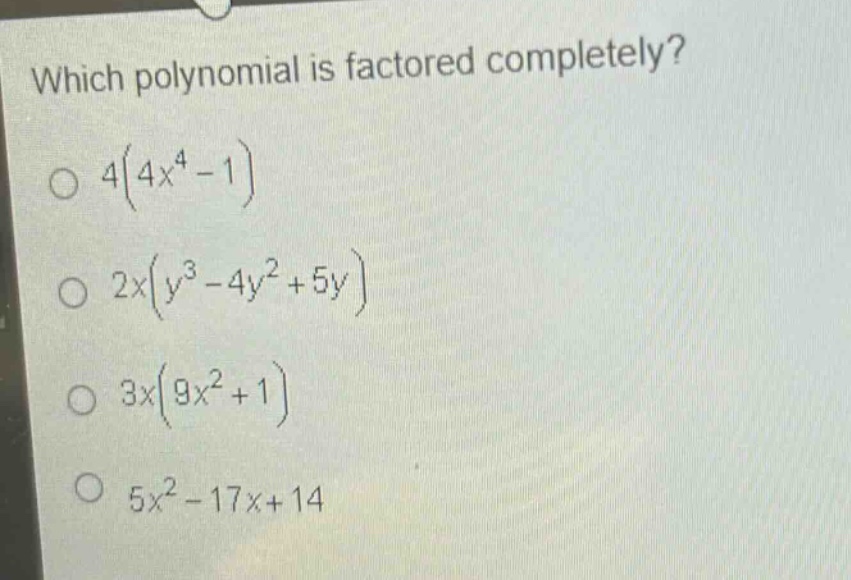
which polynomial is factored completely?\n$4(4x^{4}-1)$\n$2x(y^{3}-4y^{2}+5y)$\n$3x(9x^{2}+1)$\n$5x^{2}-17x + 14$
Answer
Answer:
C. $3x(9x^{2}+1)$
Explanation:
Step1: Analyze option A
$4(4x^{4}-1)=4((2x^{2})^{2}-1^{2})$, which can be further factored using difference - of - squares formula $a^{2}-b^{2}=(a + b)(a - b)$. So it is not completely factored.
Step2: Analyze option B
$2x(y^{3}-4y^{2}+5y)=2xy(y^{2}-4y + 5)$. The original expression is not completely factored as we can factor out $y$ from the terms inside the parentheses.
Step3: Analyze option C
The expression $3x(9x^{2}+1)$ cannot be factored further over the real - numbers. The factor $9x^{2}+1$ has no real roots since $9x^{2}+1 = 0$ gives $9x^{2}=-1$ or $x^{2}=-\frac{1}{9}$, and there are no real solutions for $x$.
Step4: Analyze option D
$5x^{2}-17x + 14$ is not in factored form. It can be factored using methods like factoring by grouping or the quadratic formula.