the polynomial function f(x) is a fourth - degree polynomial. which of the following could be the complete…
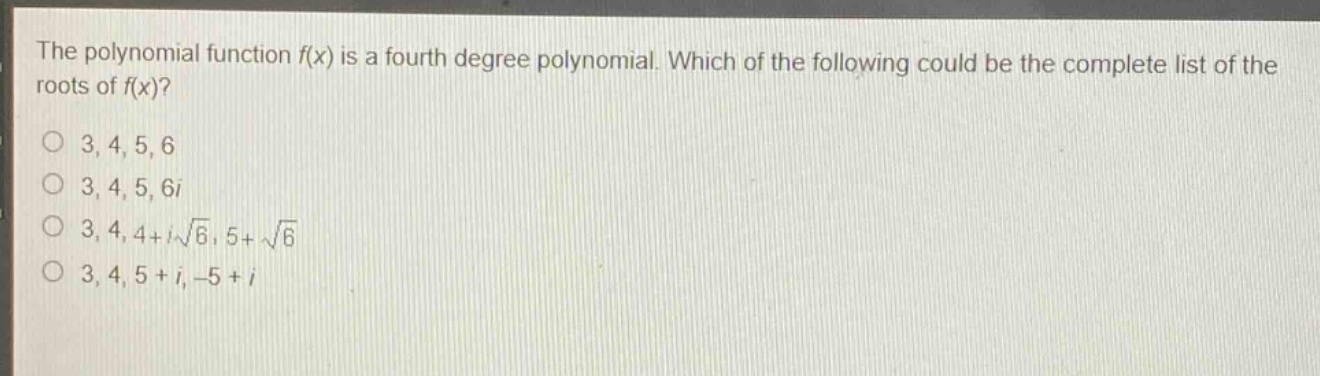
the polynomial function f(x) is a fourth - degree polynomial. which of the following could be the complete list of the roots of f(x)?\n3, 4, 5, 6\n3, 4, 5, 6i\n3, 4, 4 + i\\sqrt{6}, 5+\\sqrt{6}\n3, 4, 5 + i, - 5 + i
Answer
Explanation:
Step1: Recall conjugate root theorem
For a polynomial with real - valued coefficients, if (a + bi) is a root, then its complex conjugate (a - bi) is also a root.
Step2: Analyze option 1
The set ({3,4,5,6}) consists of all real numbers. A fourth - degree polynomial can have all real roots.
Step3: Analyze option 2
If (6i) is a root of a polynomial with real coefficients, then (- 6i) must also be a root. Since (-6i) is not in the set ({3,4,5,6i}), this cannot be the complete list of roots.
Step4: Analyze option 3
If (4 + i\sqrt{6}) is a root of a polynomial with real coefficients, then (4 - i\sqrt{6}) must also be a root. Since (4 - i\sqrt{6}) is not in the set ({3,4,4 + i\sqrt{6},5+\sqrt{6}}), this cannot be the complete list of roots.
Step5: Analyze option 4
If (5 + i) is a root of a polynomial with real coefficients, then (5 - i) must be a root. If (-5 + i) is a root, then (-5 - i) must be a root. Since (5 - i) and (-5 - i) are not in the set ({3,4,5 + i,-5 + i}), this cannot be the complete list of roots.
Answer:
A. 3, 4, 5, 6