which is the polynomial function of lowest degree with rational real coefficients, a leading coefficient of…
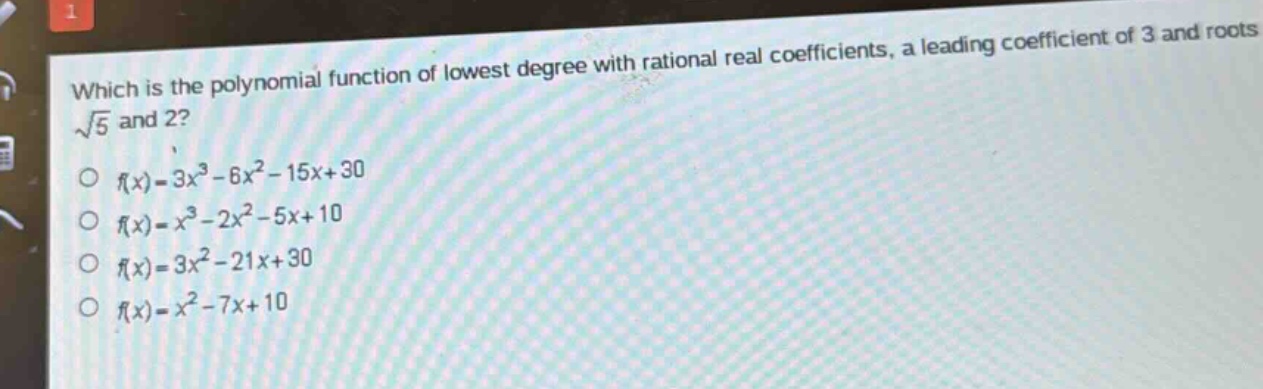
which is the polynomial function of lowest degree with rational real coefficients, a leading coefficient of 3 and roots $sqrt{5}$ and 2?\n$f(x)=3x^{3}-6x^{2}-15x + 30$\n$f(x)=x^{3}-2x^{2}-5x + 10$\n$f(x)=3x^{2}-21x + 30$\n$f(x)=x^{2}-7x + 10$
Answer
Explanation:
Step1: Recall polynomial - root relationship
If (a) is a root of a polynomial, then ((x - a)) is a factor. Given roots (\sqrt{5}) and (2), for a polynomial with rational real - coefficients, since (\sqrt{5}) is a root, its conjugate (-\sqrt{5}) is also a root. The factors of the polynomial are ((x - 2)), ((x-\sqrt{5})) and ((x + \sqrt{5})).
Step2: Multiply the factors
First, multiply ((x-\sqrt{5})(x + \sqrt{5})) using the difference - of - squares formula ((a - b)(a + b)=a^{2}-b^{2}). Here, (a = x) and (b=\sqrt{5}), so ((x-\sqrt{5})(x + \sqrt{5})=x^{2}-5). Then multiply ((x^{2}-5)) by ((x - 2)): ((x^{2}-5)(x - 2)=x^{3}-2x^{2}-5x + 10).
Step3: Adjust the leading coefficient
The leading coefficient of (x^{3}-2x^{2}-5x + 10) is (1). We want a leading coefficient of (3). Multiply the polynomial (x^{3}-2x^{2}-5x + 10) by (3) to get (f(x)=3x^{3}-6x^{2}-15x + 30).
Answer:
A. (f(x)=3x^{3}-6x^{2}-15x + 30)