if a polynomial function, (f(x)), with rational coefficients has roots 0, 4, and (3 + sqrt{11}), what must…
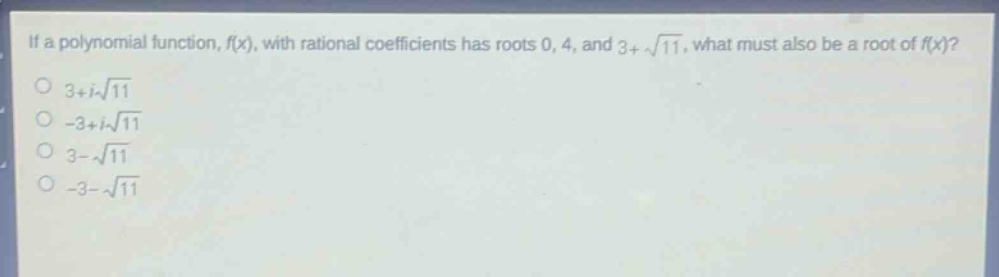
if a polynomial function, (f(x)), with rational coefficients has roots 0, 4, and (3 + sqrt{11}), what must also be a root of (f(x))?\n(3 + isqrt{11})\n(-3 + isqrt{11})\n(3-sqrt{11})\n(-3-sqrt{11})
Answer
Explanation:
Step1: Recall conjugate root theorem
If a polynomial with rational coefficients has a root of the form (a + \sqrt{b}) (where (a,b\in\mathbb{Q}) and (\sqrt{b}) is irrational), then its conjugate (a-\sqrt{b}) is also a root.
Step2: Identify the conjugate
Given the root (3+\sqrt{11}), its conjugate is (3 - \sqrt{11}).
Answer:
C. (3-\sqrt{11})