a polynomial function (f) has a zero of (-6), a zero of (4), and a zero of (-1) with a multiplicity of 2…
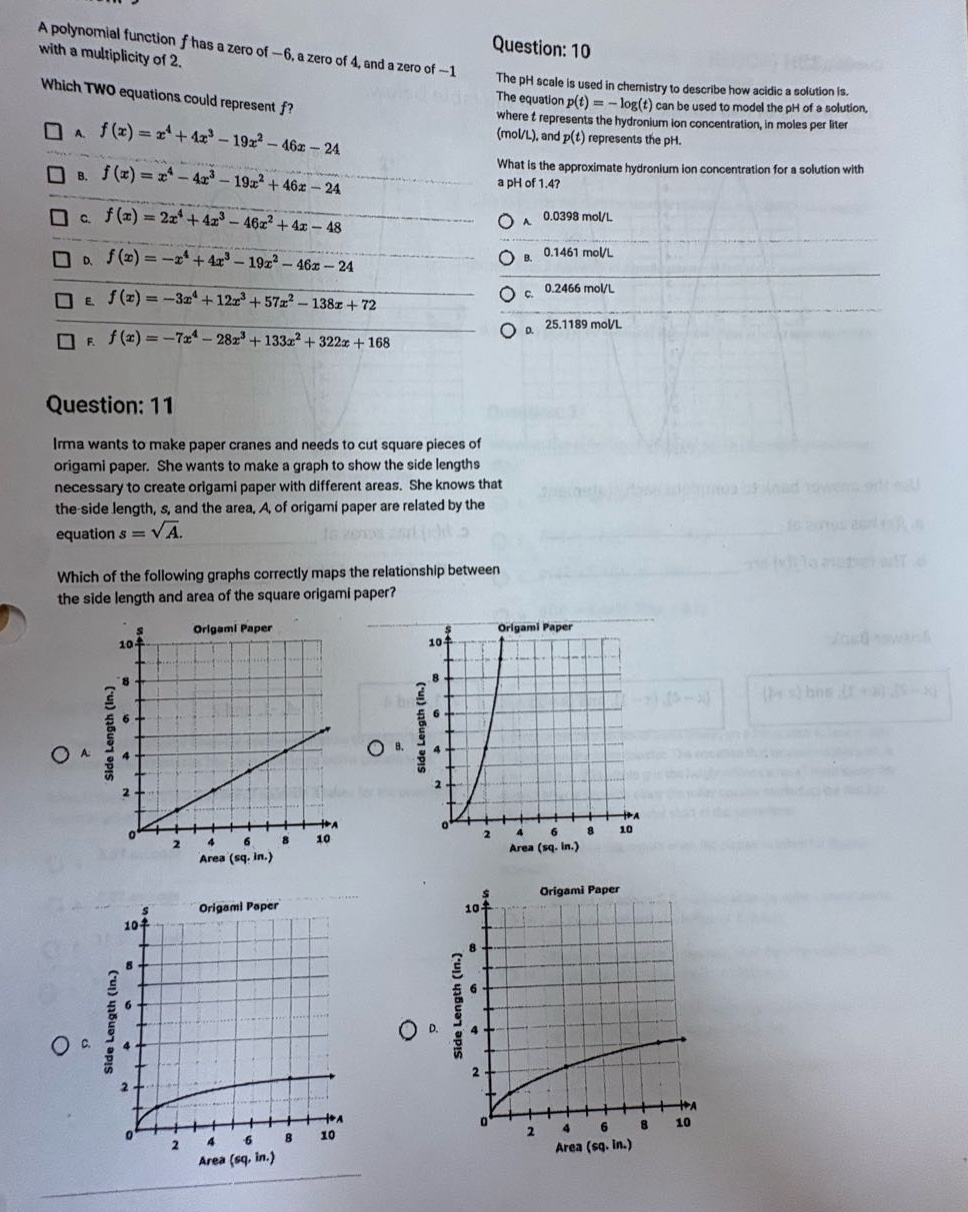
a polynomial function (f) has a zero of (-6), a zero of (4), and a zero of (-1) with a multiplicity of 2. which two equations could represent (f)? \na. (f(x)=x^{4}+4x^{3}-19x^{2}-46x - 24) \nb. (f(x)=x^{4}-4x^{3}-19x^{2}+46x - 24) \nc. (f(x)=2x^{4}+4x^{3}-46x^{2}+4x - 48) \nd. (f(x)=-x^{4}+4x^{3}-19x^{2}-46x - 24) \ne. (f(x)=-3x^{4}+12x^{3}+57x^{2}-138x + 72) \nf. (f(x)=-7x^{4}-28x^{3}+133x^{2}+322x + 168) \nquestion: 10 \nthe ph scale is used in chemistry to describe how acidic a solution is. the equation (p(t)=-log(t)) can be used to model the ph of a solution, where (t) represents the hydronium - ion concentration, in moles per liter (mol/l), and (p(t)) represents the ph. what is the approximate hydronium ion concentration for a solution with a ph of 1.4? \na. (0.0398) mol/l \nb. (0.1461) mol/l \nc. (0.2466) mol/l \nd. (25.1189) mol/l \nquestion: 11 \nirma wants to make paper cranes and needs to cut square pieces of origami paper. she wants to make a graph to show the side lengths necessary to create origami paper with different areas. she knows that the side length, (s), and the area, (a), of origami paper are related by the equation (s = sqrt{a}). which of the following graphs correctly maps the relationship between the side length and area of the square origami paper?
Answer
Question 9
Explanation:
Step1: Write the factored form of the polynomial
If a polynomial has zeros (x = a_1,a_2,\cdots,a_n) with multiplicities (m_1,m_2,\cdots,m_n) respectively, then the polynomial can be written as (f(x)=k(x - a_1)^{m_1}(x - a_2)^{m_2}\cdots(x - a_n)^{m_n}). Here, (a_1=-6,a_2 = 4,a_3=-1) with (m_1 = 1,m_2=1,m_3 = 2). So (f(x)=k(x + 6)(x - 4)(x + 1)^2). First, expand ((x + 1)^2=x^{2}+2x + 1). Then ((x + 6)(x - 4)=x^{2}+2x-24). Next, multiply ((x^{2}+2x - 24)(x^{2}+2x + 1)): [ \begin{align*} &(x^{2}+2x - 24)(x^{2}+2x + 1)\ =&x^{2}(x^{2}+2x + 1)+2x(x^{2}+2x + 1)-24(x^{2}+2x + 1)\ =&x^{4}+2x^{3}+x^{2}+2x^{3}+4x^{2}+2x-24x^{2}-48x - 24\ =&x^{4}+(2x^{3}+2x^{3})+(x^{2}+4x^{2}-24x^{2})+(2x-48x)-24\ =&x^{4}+4x^{3}-19x^{2}-46x - 24 \end{align*} ] When (k = 1), (f(x)=x^{4}+4x^{3}-19x^{2}-46x - 24) and when (k=- 3), (f(x)=-3x^{4}-12x^{3}+57x^{2}+138x + 72) (There is a sign - error in option E's coefficient of (x^{3})). When (k=-7), (f(x)=-7x^{4}-28x^{3}+133x^{2}+322x + 168)
Answer:
A. (f(x)=x^{4}+4x^{3}-19x^{2}-46x - 24), F. (f(x)=-7x^{4}-28x^{3}+133x^{2}+322x + 168)
Question 10
Explanation:
Step1: Use the pH formula
Given (p(t)=-\log(t)), and (p(t) = 1.4). We can rewrite the formula as (\log(t)=- 1.4).
Step2: Convert from logarithmic to exponential form
By the definition of logarithms, if (\log_{10}(t)=-1.4), then (t = 10^{-1.4}).
Step3: Calculate the value of (t)
(t=10^{-1.4}\approx0.0398) (using a calculator, (10^{-1.4}=\frac{1}{10^{1.4}}))
Answer:
A. (0.0398\ mol/L)
Question 11
Explanation:
Step1: Analyze the function (s = \sqrt{A})
The function (s=\sqrt{A}=A^{\frac{1}{2}}) is a square - root function. The domain of (A\geq0) (since area cannot be negative). When (A = 0), (s = 0). As (A) increases, (s) also increases, but at a decreasing rate. The general shape of the square - root function (y=\sqrt{x}) is a curve that starts at the origin ((0,0)) and increases more and more slowly.
Answer:
C.