which polynomial is prime?\n$x^{3}+3x^{2}-2x - 6$\n$x^{3}-2x^{2}+3x - 6$\n$4x^{4}+4x^{3}-2x…
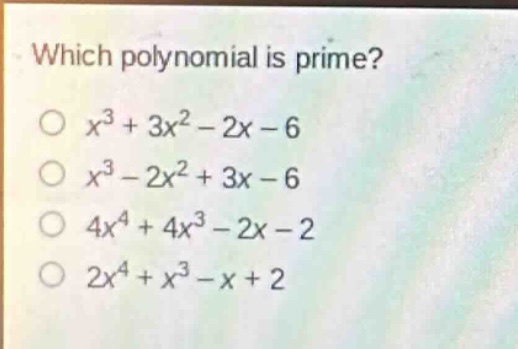
which polynomial is prime?\n$x^{3}+3x^{2}-2x - 6$\n$x^{3}-2x^{2}+3x - 6$\n$4x^{4}+4x^{3}-2x - 2$\n$2x^{4}+x^{3}-x + 2$
Answer
Explanation:
Step1: Check first polynomial for factoring
Factor by grouping: $x^{3}+3x^{2}-2x - 6=x^{2}(x + 3)-2(x + 3)=(x^{2}-2)(x + 3)$
Step2: Check second polynomial for factoring
Factor by grouping: $x^{3}-2x^{2}+3x - 6=x^{2}(x - 2)+3(x - 2)=(x^{2}+3)(x - 2)$
Step3: Check third polynomial for factoring
Factor by grouping: $4x^{4}+4x^{3}-2x - 2=4x^{3}(x + 1)-2(x + 1)=(4x^{3}-2)(x + 1)=2(2x^{3}-1)(x + 1)$
Step4: Check fourth polynomial for factoring
Try to factor $2x^{4}+x^{3}-x + 2$ by grouping. Group the terms as $(2x^{4}+x^{3})+(-x + 2)=x^{3}(2x + 1)-(x - 2)$. There is no common - factor to factor out further. Also, we cannot find roots easily using rational - root theorem (the possible rational roots are $\pm1,\pm2,\pm\frac{1}{2}$ and none of them are roots). So it is prime.
Answer:
$2x^{4}+x^{3}-x + 2$