which polynomial is prime?\n$x^{3}+3x^{2}+2x + 6$\n$x^{3}+3x^{2}-2x - 6$\n$10x^{2}-4x + 3x+6$\n$10x^{2}-10x…
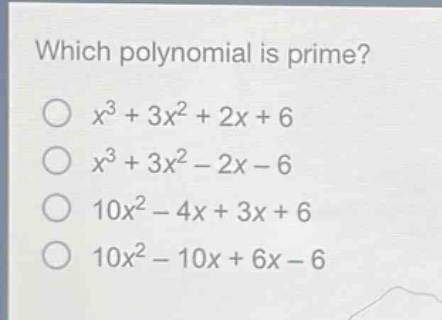
which polynomial is prime?\n$x^{3}+3x^{2}+2x + 6$\n$x^{3}+3x^{2}-2x - 6$\n$10x^{2}-4x + 3x+6$\n$10x^{2}-10x + 6x - 6$
Answer
Explanation:
Step1: Factor the first polynomial
Factor $x^{3}+3x^{2}+2x + 6$ by grouping. Group the terms: $(x^{3}+3x^{2})+(2x + 6)=x^{2}(x + 3)+2(x + 3)=(x + 3)(x^{2}+2)$.
Step2: Factor the second polynomial
Factor $x^{3}+3x^{2}-2x - 6$ by grouping. Group the terms: $(x^{3}+3x^{2})-(2x + 6)=x^{2}(x + 3)-2(x + 3)=(x + 3)(x^{2}-2)$.
Step3: Simplify and factor the third polynomial
Simplify $10x^{2}-4x + 3x+6=10x^{2}-x + 6$. For a quadratic $ax^{2}+bx + c$ ($a = 10$, $b=-1$, $c = 6$), the discriminant $\Delta=b^{2}-4ac=(-1)^{2}-4\times10\times6=1 - 240=-239<0$. So it cannot be factored over the real - numbers.
Step4: Factor the fourth polynomial
Simplify $10x^{2}-10x + 6x-6=10x^{2}-4x-6 = 2(5x^{2}-2x - 3)$. Factor $5x^{2}-2x - 3$: $5x^{2}-2x - 3=5x^{2}-5x+3x - 3=5x(x - 1)+3(x - 1)=(x - 1)(5x+3)$.
Answer:
$10x^{2}-4x + 3x + 6$