which polynomials are prime? check all of the boxes that apply.\n$x^{2}+9$\n$x^{2}-9$\n$x^{2}+3x +…
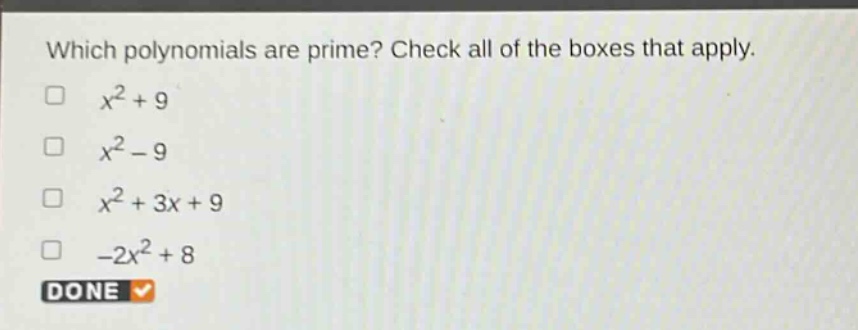
which polynomials are prime? check all of the boxes that apply.\n$x^{2}+9$\n$x^{2}-9$\n$x^{2}+3x + 9$\n$-2x^{2}+8$\ndone
Answer
Explanation:
Step1: Recall prime polynomial definition
A prime polynomial cannot be factored over the real - numbers.
Step2: Analyze $x^{2}+9$
We try to factor $x^{2}+9$. Using the difference - of - squares formula $a^{2}-b^{2}=(a + b)(a - b)$, but $x^{2}+9=x^{2}-(-9)$ and $\sqrt{-9}$ is not a real number. So $x^{2}+9$ is prime over the real numbers.
Step3: Analyze $x^{2}-9$
We use the difference - of - squares formula $a^{2}-b^{2}=(a + b)(a - b)$. Here $a = x$ and $b = 3$, so $x^{2}-9=(x + 3)(x - 3)$. It is not prime.
Step4: Analyze $x^{2}+3x + 9$
For a quadratic polynomial $ax^{2}+bx + c$ ($a = 1$, $b = 3$, $c = 9$), we check the discriminant $\Delta=b^{2}-4ac$. $\Delta=3^{2}-4\times1\times9=9 - 36=-27<0$. Since the discriminant is negative, it cannot be factored over the real numbers, so it is prime.
Step5: Analyze $-2x^{2}+8$
First, we factor out the greatest common factor: $-2x^{2}+8=-2(x^{2}-4)$. Then, using the difference - of - squares formula on $x^{2}-4=(x + 2)(x - 2)$, so $-2x^{2}+8=-2(x + 2)(x - 2)$. It is not prime.
Answer:
$x^{2}+9$, $x^{2}+3x + 9$