if (r) and (s) are positive real numbers, which expression is equivalent to (\frac{r^{2/3}s^{1/2}}{rs})?\na…
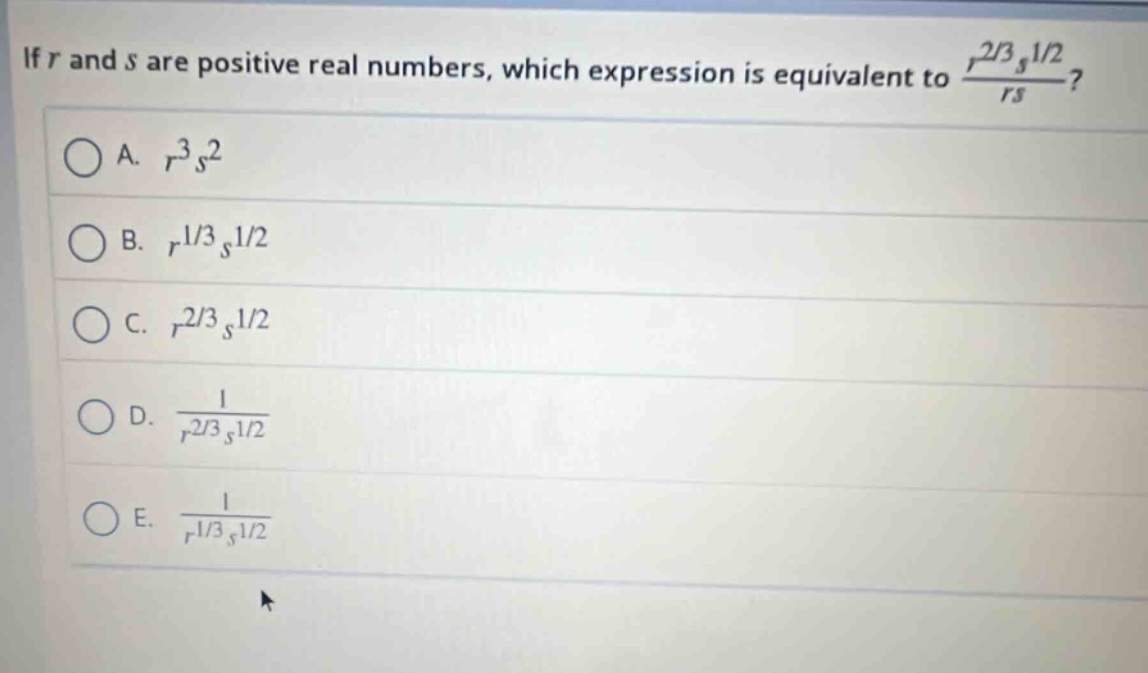
if (r) and (s) are positive real numbers, which expression is equivalent to (\frac{r^{2/3}s^{1/2}}{rs})?\na. (r^{3}s^{2}\nb. (r^{1/3}s^{1/2}\nc. (r^{2/3}s^{1/2}\nd. (\frac{1}{r^{2/3}s^{1/2}}\ne. (\frac{1}{r^{1/3}s^{1/2}})
Answer
Explanation:
Step1: Use exponent - division rule
When dividing terms with the same base (a^m\div a^n=a^{m - n}). For the given expression (\frac{r^{2/3}s^{1/2}}{rs}), we can split it into two parts: (\frac{r^{2/3}}{r}\times\frac{s^{1/2}}{s}).
Step2: Apply the rule to (r) - terms
For (\frac{r^{2/3}}{r}), since (r = r^1), then (\frac{r^{2/3}}{r^1}=r^{\frac{2}{3}-1}=r^{\frac{2 - 3}{3}}=r^{-\frac{1}{3}}).
Step3: Apply the rule to (s) - terms
For (\frac{s^{1/2}}{s}), since (s = s^1), then (\frac{s^{1/2}}{s^1}=s^{\frac{1}{2}-1}=s^{\frac{1 - 2}{2}}=s^{-\frac{1}{2}}).
Step4: Rewrite the result
The expression (r^{-\frac{1}{3}}s^{-\frac{1}{2}}) can be rewritten as (\frac{1}{r^{1/3}s^{1/2}}) using the negative - exponent rule (a^{-n}=\frac{1}{a^n}).
Answer:
E. (\frac{1}{r^{1/3}s^{1/2}})