what are the potential solutions of $log_4 x+log_4(x + 6)=2$?\n$x=-2$ and $x=-8$\n$x=-2$ and $x = 8$\n$x=2$…
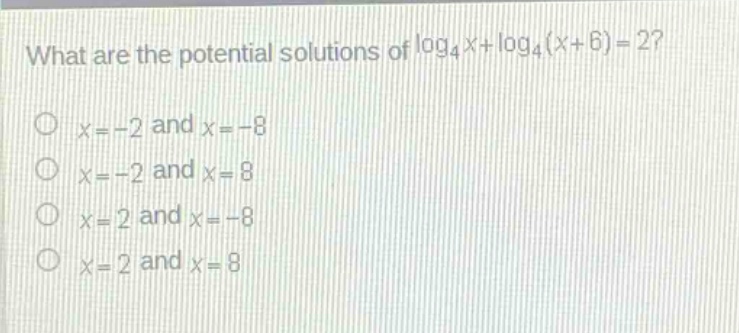
what are the potential solutions of $log_4 x+log_4(x + 6)=2$?\n$x=-2$ and $x=-8$\n$x=-2$ and $x = 8$\n$x=2$ and $x=-8$\n$x=2$ and $x = 8$
Answer
Explanation:
Step1: Apply log - product rule
Using the rule $\log_aM+\log_aN = \log_a(MN)$, we rewrite $\log_4x+\log_4(x + 6)$ as $\log_4[x(x + 6)]$. So the equation becomes $\log_4[x(x + 6)]=2$.
Step2: Convert to exponential form
By the definition of logarithms, if $\log_ab=c$, then $b=a^c$. So $x(x + 6)=4^2$.
Step3: Expand and simplify
Expand $x(x + 6)$ to get $x^2+6x$. Then $x^2+6x = 16$, which can be rewritten as $x^2+6x-16=0$.
Step4: Factor the quadratic equation
Factor $x^2+6x - 16$ as $(x + 8)(x - 2)=0$.
Step5: Solve for x
Setting each factor equal to zero gives $x+8 = 0$ or $x - 2=0$, so $x=-8$ or $x = 2$.
Step6: Check for domain
For $\log_4x$ and $\log_4(x + 6)$ to be well - defined, $x>0$ and $x+6>0$. When $x=-8$, $\log_4(-8)$ and $\log_4(-8 + 6)=\log_4(-2)$ are undefined. When $x = 2$, $\log_42$ and $\log_4(2 + 6)=\log_48$ are defined.
Answer:
$x = 2$ and $x=8$ (Note: After checking the domain, we discard $x=-8$ and $x=-2$ from the initial solutions obtained from the quadratic equation. The correct non - discarded solutions from the given options are $x = 2$ and $x = 8$)