a prism has 2 congruent hexagonal bases like the one shown. each hexagon is made from 2 congruent isosceles…
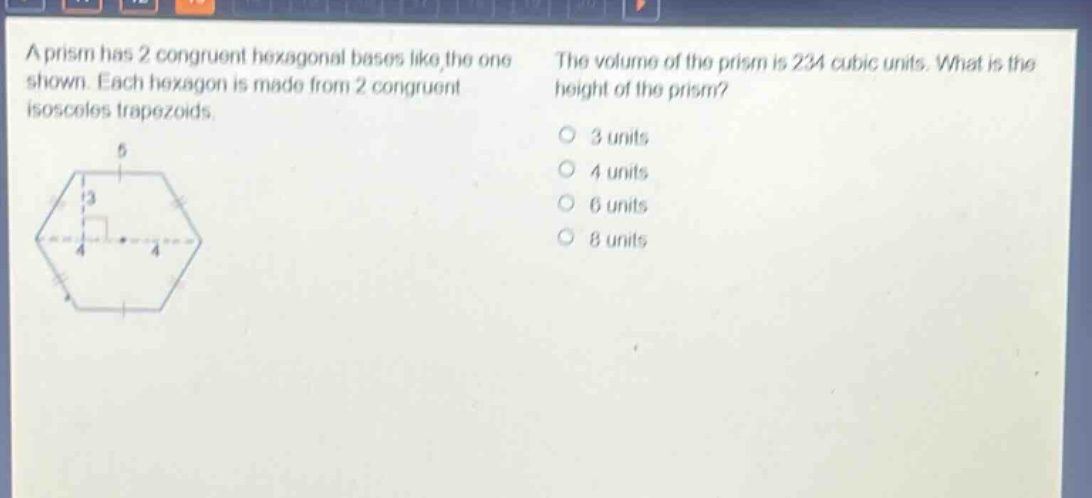
a prism has 2 congruent hexagonal bases like the one shown. each hexagon is made from 2 congruent isosceles trapezoids. the volume of the prism is 234 cubic units. what is the height of the prism? 3 units 4 units 6 units 8 units
Answer
Explanation:
Step1: Calculate the area of the hexagonal base
The hexagon is made of 2 congruent isosceles trapezoids. The formula for the area of a trapezoid is $A=\frac{(a + b)h}{2}$, where $a$ and $b$ are the lengths of the parallel - sides and $h$ is the height. For each trapezoid, $a = 4$, $b=4 + 4=8$, and $h = 3$. So the area of one trapezoid is $A_1=\frac{(4 + 8)\times3}{2}=\frac{12\times3}{2}=18$ square units. The area of the hexagon (which is composed of 2 such trapezoids) is $A = 2\times18=39$ square units.
Step2: Use the volume formula of a prism
The volume formula of a prism is $V=Ah$, where $V$ is the volume, $A$ is the area of the base, and $h$ is the height of the prism. We know that $V = 234$ cubic units and $A = 39$ square units. Rearranging the formula for $h$, we get $h=\frac{V}{A}$. Substituting the values, $h=\frac{234}{39}=6$ units.
Answer:
6 units