which properties are present in a table that represents an exponential function in the form $y = b^{x}$ when…
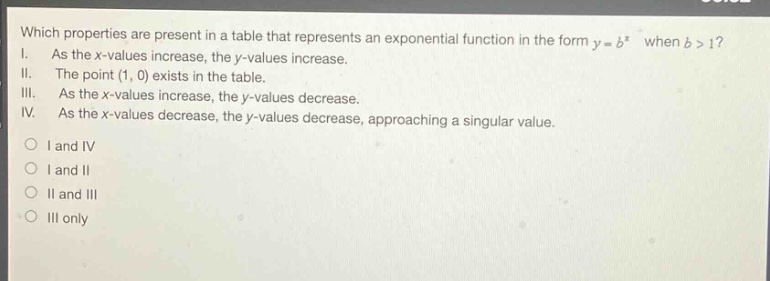
which properties are present in a table that represents an exponential function in the form $y = b^{x}$ when $b>1$?\ni. as the x - values increase, the y - values increase.\nii. the point $(1,0)$ exists in the table.\niii. as the x - values increase, the y - values decrease.\niv. as the x - values decrease, the y - values decrease, approaching a singular value.\no i and iv\no i and ii\no ii and iii\no iii only
Answer
Brief Explanations:
- For an exponential function (y = b^{x}) with (b>1), as (x) increases, (y) increases. For example, if (b = 2), when (x = 1,y=2); when (x = 2,y = 4). So, statement I is correct.
- Substitute (x = 1) into (y=b^{x}), we get (y=b\neq0) when (b > 1). So the point ((1,0)) does not exist in the table, and statement II is incorrect.
- Since (b>1), as (x) increases, (y) increases, not decreases. So statement III is incorrect.
- As (x) decreases (i.e., (x\rightarrow-\infty)), (y=b^{x}\rightarrow0) for (b > 1). So as (x) - values decrease, (y) - values decrease approaching the singular value (0), and statement IV is correct.
Answer:
I and IV