which property does each equation demonstrate?\n$x^{2}+2x = 2x+x^{2}$\n$(3z^{4}+2z^{3})-(2z^{4}+z^{3})=z^{4}+…
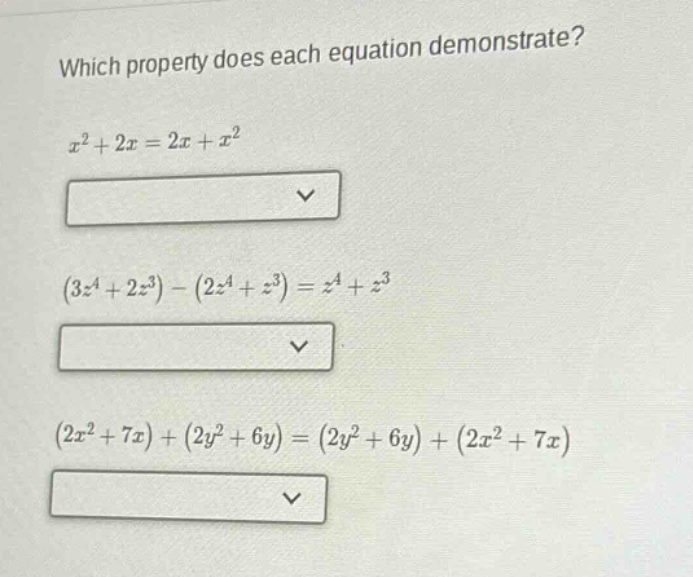
which property does each equation demonstrate?\n$x^{2}+2x = 2x+x^{2}$\n$(3z^{4}+2z^{3})-(2z^{4}+z^{3})=z^{4}+z^{3}$\n$(2x^{2}+7x)+(2y^{2}+6y)=(2y^{2}+6y)+(2x^{2}+7x)$
Answer
Brief Explanations:
- For the equation $x^{2}+2x = 2x+x^{2}$, the order of the terms $x^{2}$ and $2x$ is changed. The commutative - property of addition states that for any two real numbers $a$ and $b$, $a + b=b + a$. Here $a=x^{2}$ and $b = 2x$.
- For the equation $(3z^{4}+2z^{3})-(2z^{4}+z^{3})=z^{4}+z^{3}$, we simplify the left - hand side by combining like terms. First, distribute the negative sign: $3z^{4}+2z^{3}-2z^{4}-z^{3}=(3z^{4}-2z^{4})+(2z^{3}-z^{3})=z^{4}+z^{3}$. This is an example of combining like terms.
- For the equation $(2x^{2}+7x)+(2y^{2}+6y)=(2y^{2}+6y)+(2x^{2}+7x)$, the order of the two groups of terms $(2x^{2}+7x)$ and $(2y^{2}+6y)$ is changed. The commutative property of addition for expressions also holds here.
Answer:
- Commutative property of addition
- Combining like terms
- Commutative property of addition